Sunday, October 27, 2019

Review: His Hideous Heart

His Hideous Heart His Hideous Heart by Dahlia Adler
My rating: 4 of 5 stars

What a perfectly gloomy, rainy day to post a review of Poe and his devotees.

Quick reminder that, while I work for the publisher of this book, my thoughts and opinions about it are entirely my own.

Okay, so admittedly I picked this one up more because it’s frankly a scandal that I haven’t read more Poe by this point in my literary life—so, success! I’m assuming this book is as much about encouraging enjoyment of classic Gothic horror as it is about entertaining with the retellings, and it worked for me. I’d read the Poe first (trying not to stab people on the subway with my pencil while underlining vocab words) and then read the retelling.

It was a great way to get me started. I remember being frustrated even by stories I enjoyed in high school, like “The Masque of the Red Death”, so knowing I’d have the modern adaptations as breaks helped get me started. And guess what? Surprise, surprise (sarcasm—I really shouldn’t have been), post-English major it is now far easier for me to comprehend what’s going on. Doesn’t mean there isn’t still an unusually high number of words that I don’t understand—hence the subway pencil adventures.

As in any collections, I found some of the adaptations worked better than others for me. A few, like “She Rode a Horse of Fire” (“Metzengerstein”), “Red” (“The Masque of the Red Death”), and even “It’s Carnival!” (“The Cask of Amontillado”) (the last of which I did like) were basically just straightforward modern adaptations of the story. The ones I enjoyed the most had more of a twist to them, like:

>> “Night-Tide”, a story that recast the poem Annabel Lee as a tragic and touching historical love story between two young women who meet at a seaside resort each year

>> “A Drop of Stolen Ink” which put a light sci-fi spin on “The Purloined Letter” and builds a robust, complex world in a short story

>> “Happy Days, Sweetheart”, which recasts “The Telltale Heart” in light of the frustration many women felt in the wake of the 2016 election and that women of color face every day of their lives. The final sentence is an absolutely fantastic sendup of the original story’s end—my eyebrows jumped so high, the in-public equivalent of a jaw-drop!

>> “The Oval Filter”, an adaptation of “The Oval Portrait” that turned Poe’s straightforward and, to me, dull-ish story into a mystery with a, to me, more Poe-ish ending—and which, sadly, may not age well since the “portrait” is now a series of Instagram photos

and

>> “The Murders in the Rue Apartelle, Boracay,” which relocated “The Murders in the Rue Morgue” to an urban fantasy Philippines and gave us a trans protagonist with an unhesitant love interest and an ending that still surprised…if maybe not quite as much as the flabbergasting ending of Poe’s original

And then there was “The Raven (Remix)”, a found poem/short and creepy ghost story created by blacking out, well, almost all of the original poem. I was impressed the author found it there, but also a little put out by how much of the original poem was gone. So mixed feelings on that one.

As for Poe’s stories, well, I’m still going to be a die-hard fan of “The Cask of Amontillado” and “The Raven”—the first for how much is said in so little (I love that we’re never really given a reason why Montresor is getting revenge on Fortunato—Jackson gives us a little more info), and the second for its intricate rhyme scheme and ironic fatalism. I’m not even going to try to defend myself for those cliché reasons to like those two, okay? But I also enjoyed discovering “Hop-Frog” and the first detective story ever, “The Murders in the Rue Morgue” (as delightfully ridiculous as it was).

Now, I do have to admit that Adler’s editing of this collection disappointed me. It seems to me that the whole point of separating the adaptations from the originals might be to whet readers’ appetites for the genre, so that someone reading straight from front to back might venture into the Poe once they completed the retellings. But Poe is not necessarily easy for many people to read; I loved Frankenstein in high school but, at the same time, I struggled with “The Masque of the Red Death”—and this text offers no help whatsoever. Latin and French go untranslated, antiquated and SAT-level vocab goes undefined, and cultural allusions go unglossed.

I was also perplexed by a couple of the story versions selected for printing. “Hop-Frog” seemed to be a 1912 version that had what appears to be a misspelling (three earlier editions had the word “flax” instead of “flu”, which makes more sense to me in context). Only “Hop-Frog” and “The Murders in the Rue Morgue” had a few annotations and one spelling correction/modernization, but those notes were made by previous editors of now-Public Domain collections, not by Adler. The inconsistency between absolutely no helpful notes and a smattering of them in two stories was strange and a bit jarring, especially since there are plenty of Public Domain versions to choose from. [Also, I know it’s not required for Public Domain works, but none of the stories’ sources were cited. C’mon, really?]

So yeah, in my opinion there wasn’t enough heavy lifting on the editing in the Poe part of this collection. Translations of the Latin and French would be, to me, the bare minimum.

But I’m a nerd, and I had a lot of fun annotating my copy with all this info. So…maybe I owe Adler thanks for letting me geek out and look up vocab, forgotten 19th-century writers, 17th century convicts-turned-undercover-cops (seriously, look up Eugene Vidocq, he’s incredible), and Greek mythological figures. (And please don’t tell me I wasted my time doing this because annotated copies already exist. I know. I know.)

I still whole-heartedly recommend this perfect Halloween read for lovers of creepy short stories, Victorian Gothic horror, and, of course, Edgar Allan Poe.


Quote Roundup in order of appearance

I feel horrible saying this, but frankly I thought the very first story, a straight-forward retelling, was the most boring of the bunch. The second, “The Glittering Death” for “The Pit and the Pendulum”, was more of a departure and seemed to sit squarest in the horror genre, but also didn’t do much for me--though the person writing in the New York Times Book Review loved it, so obviously this is a matter of opinion! For me,His Hideous Heart hit its stride with the third story, “Night-Tide”.

p. 59) [A serial killer is on the loose and an FBI officer is telling kids to be prepared.]
“So here’s a little practical advice” …
“Fuck, why don’t we all just lock ourselves in our bedrooms until we’re thirty?” Mark rolled his eyes, seeking our agreement, but we left him hanging.
It wasn’t his fault. He’s gay, but he’s a boy, and he hasn’t heard the exact same advice spewed at him about every activity that might get him out of the house. Going to the mall? Make sure people know where you are! Staying out late? Keep your phone with you at all times! Going to a party? Don’t you dare leave your drink unattended!
There are so many reasons why guys should read this collection as well as girls (okay, mostly because it’s just plain good). No matter how times we women/women-presenting people say this, guys just don’t seem to get it.

p. 65) A vocab word in the modern section! Don’t worry, I’m not going to type up everything (anything) in the Poe part, but for the modern bits…
gelid: very cold, icy.

p. 114) Bottom line: People didn’t like me, and the cruelest twist was that what they didn’t like were the precise qualities that made me worthy of winning.
I…hardly know where to start quoting “Happy Days, Sweetheart". Seriously, just about every other page has a dog-ear. There are so many references to the 2016 election, to the crap that women and especially women of color have to put up with, and then just some great writing. Like Poe did in the original story, Kuehn fits a lot of emotion in a little space.

(view spoiler)

p. 143) More vocab, which I ought to have looked up ages ago.
unseelie: evil and malevolent fairies
seelie: good and benevolent fairies

p. 179) jacquard: fabric with an elaborate pattern made on a jacquard loom (a frickin’ complicated looking thing invented in the 1700s that simplified weaving those complex patterns and apparently used paper punch cards to set the patterns, which makes me think of early computers)

p. 193) I liked the idea behind “The Fall of the Bank of Usher,” but it felt a little rushed at times, like a couple descriptive words were missing, just enough to disorient me. I can’t help but feel that maybe Wilde tried to do a little too much with a little too little space. I think it would have made a better novella.

(view spoiler)

p. 276) …in truth, the characteristics of my beloved, her rare learning, her singular yet placid cast of beauty, and the thrilling and enthralling eloquence of her low musical language, made their way into my heart…
I had so much respect for Poe in this moment. The very first reason the narrator lists for falling in love with Ligeia is her intelligence. Can’t have been very common in the ~1830s!

p. 405) As he spoke, the lady Madeline (for so she was called) passed slowly through a remote portion of the apartment… I regarded her with utter astonishment… Her figure, her air, her features—all, in their very minutest development were those—were identically, (I can use no other sufficient term,) were identically those of Roderick Usher who sat beside me.
I was so excited when I read this to see what someone writing today would do with it. The result wasn’t quite as gender-bending as I’d hoped, but still had a pretty darn good message about identity attached to it.

p. 428) I was astonished by how much the setup for "The Murders in the Rue Morgue” resembled the setup for the Sherlock Holmes stories. One can only wonder whether, if Poe had survived, Aguste Dupin would now be the best-known detective with the most associated film and book adaptations of any fictional hero, instead of Conan Doyle’s creation.

Finally, finally, we reach the end of this epic review:

I was a bit confused by the decision to include “The Murders in the Rue Morgue,” the story that introduced detective Auguste Dupin, after “The Purloined Letter,” one of his later adventures and one that had a far denser and less reader-friendly beginning. I mean, I totally get and agree with wanting to use “The Murders in the Rue Apartelle, Boracay” as the crowning piece of the collection—I would gobble up a whole book set in this world!—but “A Drop of Stolen Ink” is also excellent and wouldn’t be a bad last note. Actually, the final punch of “Happy Days, Sweetheart” would have been a perfect final punch for the whole collection, especially because it’s based on Poe’s most famous tale, “The Tell-Tale Heart”, and the one that gave the collection its title.

View all my reviews

Saturday, October 19, 2019

Review: Tears of the Trufflepig

Tears of the Trufflepig Tears of the Trufflepig by Fernando A. Flores
My rating: 4 of 5 stars

I've wanted to read this ever since I read the title in my report--and Flores did not disappoint. Perhaps not as totally bonkers as I expected, but somehow that made it work even better. It's more fantastic than Robin Sloan's Sourdough but only because the world is slightly different than ours--though realistically so. Realistically enough that I was a bit horrified when I read his description of the border between the U.S. and Mexico, because it sounds much more plausible than a wall.

Also...I think would like a Trufflepig for a pet. (view spoiler)

The language was beautiful overall, though there were a couple places where it felt a bit overwritten...like the very first page, on which Bellacosa "stomped down hard and fine orange dust lifted and formed a ghost in his own image, eager to dance or play cards." Um...what? My brain had to grapple with the idea of a dust cloud in someone's image. Even in a book smacking of magical realism, that didn't quite make sense to me--not least because, as I went on, this kind of unlikely situation and the flowery last phrase of my quote were not typical of the rest of the book.

Flores's environments in southern Texas and northern Mexico are so realistically described that the atmosphere is almost palpable, even the parts that are clearly more on the fantastic side of the divide. That feast of filtered animals--setting aside the disgust that might go with reviving an extinct species only to kill them for food--was delicious.

Also nice was that the women characters had wonderful, colorful personalities even if they weren’t main characters. Fortune tellers, dinner guests and illegal feast emcees, artists and musicians daylighting as waitresses, even the dream-versions of Bellacosa’s wife and daughter felt rounded and interesting as characters in their own right instead of simply as props. No gratuitous sex/love between the main character and inappropriately younger women. Hallelujah!

Despite juggling many moving parts--noir-esque, realistic, fantastic, mystical--Flores managed to bring everything together in a satisfyingly and possibly interpretable conclusion.

It's a bit of a slow start, but I do recommend this book for anyone with a little patience and an appreciation of the weird/magical realistic.

Quote Roundup

p. 36) One more oddball overwriting moment:
The sky grimaced like an old retiree counting change.
The sky grimaced? What is that even supposed to mean?

p. 103) “I’m not a member of the Government Daily or anything like that. I’m a journalist, like R. Murrow, abiding by the Truth-perception standards of the day. … We will have to eat and try everything they serve, no matter how disgusting it is in reality. A high-class affair, in other words.”
Come for the creepy Government vs. “Truth-perception” commentary in our post-factual world, stay for the .01% barbs.

p. 200) “…Sopo had to climb their volcano god Huixtepeltinico and rescue what academics from a certain era referred to as ‘el cerdo reptil’—a term first coined by the Mexican historian Dr. Lazara Carranza, somewhat crudely translated by himself as “the Trufflepig.”
Very crudely. Even I, without a scrap of Spanish beyond “hola” and “gato”, can tell that “el cerdo reptile” has nothing to do with the words “truffle” or “pig”. Probably part of the humor.

p. 216) vocab: capsicum: pepper / tropical American herbs and shrubs of the nightshade family. The context is “they walked into the capsicum fog”, so I can’t say I’m any more enlightened than I was before…

p. 218) No idea why the TV has been called a replica instead. I can kind of understand how “filtering” might be derived from scientific process that we don’t understand, but there aren’t really hints of what makes a “replica” different from a TV.

p. 243-244) The Trufflepig was beginning to disturb Bellacosa. Then, strangely, the creature gave him some kind of assurance. He felt that if a Trufflepig could happen, that anything could happen, and Bellacosa began thinking of it as a kind of Tex-Mex platypus.
Yes, please, I’ll take one.

p. 277) Here’s where we find out how there are two boarder walls and how a third can even be considered: (view spoiler).


View all my reviews

Thursday, October 10, 2019

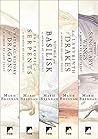
Review: The Complete Memoirs of Lady Trent Series: A Natural History of Dragons, The Tropic of Serpents, The Voyage of the Basilisk, In the Labyrinth of Drakes, ... Sanctuary of Wings

The Complete Memoirs of Lady Trent Series: A Natural History of Dragons, The Tropic of Serpents, The Voyage of the Basilisk, In the Labyrinth of Drakes, ... Sanctuary of Wings The Complete Memoirs of Lady Trent Series: A Natural History of Dragons, The Tropic of Serpents, The Voyage of the Basilisk, In the Labyrinth of Drakes, ... Sanctuary of Wings by Marie Brennan
My rating: 4 of 5 stars

View all my reviews

Dang it, I lost my review. That's what I get for stepping away from my computer overnight in mid-review.

Well, the major point was that I felt it was both simultaneously too short--because I thoroughly enjoyed it--and too long. Brennan's worlds feel so rich and colorful, to say nothing of Isabella. Brennan's ability to capture a setting with all the senses is so brilliant that at times I think it may have overwhelmed some of the personalities of background characters. I was also impressed with how much was packed in plot-wise without feeling rushed, at least until the end of the last book.

So, why did I think the series was too long? The fourth book felt a little slow, less world-building-y, and predictable until (view spoiler), and the fifth book took a little longer to get through the winter than I might have wished. Probably if I'd read the books as they published instead of all at once I would have been swept up each time. Actually, I probably wouldn't have gone past the first book, what with my aversion to getting involved with series. So for that reason, I'm glad I only found this series when the last book published.

The books also follow Victorian travel-writing conventions almost to a fault: we have little information about "off screen" characters, which became especially frustrating after Isabella (view spoiler). And finally, I actually wished there were a few more details about dragon study. I shed an internal tear every time Isabella referred us to one of her more scholarly works.

Once again, I am behind on reviews, so I will skip to the quotes and move on. I did read this on a tablet, since I didn't want to take four books with me on my honeymoon, so I don't know what those page counts are based on, as there isn't a print omnibus edition.

QUOTE ROUNDUP
Bursting with spoilers, folks. Read on at your own risk.

Book 2: The Tropic of Serpents

p. 380) The Moulish have few possessions, and little concern for personal property as most of us see it. Their way of living neither permits it nor derives much benefit from it. To own more than you can carry is folly; you will have to abandon it when the camp moves. But most of the things you own--if the "you" in this instance is Moulish--are easily replaced anyway, so their abandonment is no great loss. To try and hoard more than those around you have is a grave insult to social harmony and, I think, to the spirits; it invites ridicule from your fellows and, if that fails, more aggressive methods of forcing you to share. From this the Moulish get their reputation as thieves, but that word belongs to a different world.
See? A fascinatingly different culture for us 'Muricans (though slightly familiar from my anthropology class) with a healthy trace of social commentary for the reader. Brennan is brilliant at this.

p. 386) All those of a given age group within the camp are brothers and sisters, as all those above them are mothers and fathers, or (if older still) the camp's elders.
This is kind of community sounds like a dream, to me.

p. 446) "We have the forest. You are villagers, and our home will eat you."
Wickedest mic drop ever.

p. 491) Despite the unsightly scar on my arm, there was a part of me that thought in delight: I've been bitten by a dragon!
Have I mentioned that I love Isabella?


Book 3: The Voyage of the Basilisk

p. 590) If I had been outrageous on previous expeditions, I found myself surprisingly reluctant to behave in such ways in front of my son. The nobler part of me said that I did not want to set a bad example for him. The selfish part said that I did not want him to think less of me. But which sort of mother would I rather be? The sort who did not go swimming without a proper costume--which in those days consisted of voluminous pantaloons and a knee-length overdress, all in a stiff fabric which would not cling when wet--or the sort who did what she had sailed halfway around the world to do?
"Very well," I said. "Let us go swimming with dragons."

p. 674)(view spoiler)

p. 678) It has been so very long since there was any satisfying scandal about me. I find that respectability grows wearisome after a time, when one is accustomed to being a disgrace.


Book 4: In the Labyrinth of Drakes

p. 841) "Umm Yaqub" was my appellation there: parents are commonly known as the mothers and fathers of their children, and "Yaqub" is the Akhian form of "Jacob."
I loved this detail...and the thought that parents can, essentially, choose their own names when they choose their child's.

p. 896) My outraged squawk startled lizards back into the rocks. "It was not a love note!"
"From you? 'A piece of research material' is as good as a lock of your hair, tied up in a scented ribbon."
I may have mentioned that I love Isabella, but I also love her brother Andrew.

p. 897) "Ah yes," I said ironically. "I have made myself exceptional. It is a wonderful game, is it not? Because I am exceptional, anything I achieve does not reflect on my sex, for of course I am not like them. Strange, though, how that division seems to vanish when we are speaking instead of my shortcomings. Then I am a woman, like any other."

p. 910) There were descriptions of my beauty that likened me to a camel--a high compliment in that society, but in my case both unfounded and not at all an aesthetic I could comprehend.

Not quite sure why I found so many quotes in book 4, when I said it was the one I found slowest. Weird.

p. 927) The pronoun pulled me up short. "She? Your physician is a woman?"
Mahira looked scandalized. "Do you think I would allow a man to examine my body?"
When she put it that way, I could hardly say that I took it for granted. As some of my readers may know, the first university in Akhia was founded by a woman--the mother of one of the caliphs--and apparently she had been in favor of training women physicians, so as to uphold propriety while also caring for the patient's health.
If only people had thought that way in the real world...

p. 955) There is a proverb that says, To a man with a hammer, everything looks like a nail. If I had a gun, it would shape my thinking; the violent response would always be there.
Say it louder for the 2nd Amendment defenders in the back, Isabella!

p. 968) (view spoiler)


Book 5: Within the Sanctuary of Wings

p. 1080) The Mrtyahaima proper lay behind, beyond my vision, rising even higher than I could imagine. Had I seen what I faced while still in Parshe...I believe I would have continued, for my life has been a recurrent tale of my failure to truly understand my peril until it is too late for me to turn back. But I cannot be certain.

p. 1102) "No." Thu sat very upright, then said in a rush, "She wants to know if all four of us are your husbands."
I read about this in my anthropology class: a researcher wrote about a Himalayan culture in which several brothers would marry one woman to avoid splitting up inherited land. Pretty sure it was debunked, but it was fun to see it in here!

p. 1112) A part of my mind was constantly examining my research, asking at every turn, And what else? It was a peculiar feeling. On the one hand, I lamented the loss of my girlish glee, the sense that it was enough simply to learn a new thing and record it for other people to learn. On the other hand, it was also exhilarating, for I was challenging myself to look further, to think harder, to fit what I saw into a larger picture and then tease out its implications.

p. 1160) In my defense I can only say that I had spent my entire tenure in that village either unconscious, in hysterics, or reeling from the flood of new information; and as a consequence, I had the attention span of a gnat: no sooner did I begin pondering one aspect of the puzzle than some equally interesting angle distracted me.

p. 1171) It was hard enough when I must explain myself in my native tongue; in Draconean, I could barely string together an entire sentence that was not about yaks.


VOCABULARY
I used to keep track of new words I learned in each book (even if I could figure it out with context)...at least until I started reading on the subway and pulling out a pencil meant I might elbow someone. It didn't occur to me until near the end of book three that it's much easier to mark words on a tablet.

Definitions are from my old friend Merriam-Webster (okay, online) unless otherwise noted.

p. 735) caeliger - Fortunately, this one's so important to the book that there was an illustration, otherwise I might have been totally lost. Unfortunately, I'm also skunked...that is to say, I have the illustration but I'm tired so I'm not going to look anymore. Gosh I love doing vocabulary for myself instead of school! (Also, fun fact, if Brennan invented this word for her books, in Latin "caeliger" is an adjective that means "heaven-supporting" [at least according to Wiktionary]).

p. 775) lapidary - I kind of figured this one out from context, but its "a cutter, polisher, or engraver of precious stones"

p. 801/1080) propitiate - "To gain or regain the goodwill or favor of; appease"

p. 805) alluvial -
1. Unhelpful: "relating to, composed of, or found in alluvium"
2. More helpful: "clay, silt, sand, gravel, or similar detrital material deposited by running water"

p. 806/907) stelae/stela - "a usually carved or inscribed stone slab or pillar used for commemorative purposes" (the first is pural)

p. 867) bivouac - "a usually temporary encampment under little or no shelter"/"for a night"

p. 897) onager - "an Asian wild ass (Equus hemionus onager)". Feast your eyes.

p. 1035) developmental lability - In Brennan's world, I took this to refer to the fact that dragons can change physiologically simply by changing the circumstances of the eggs, the way crocodiles and alligators can change the sex of their offspring by adjusting the temperature in their nests. I was getting a lot of technical papers when I looked up the phrase, but lability is, broadly, "readily or continually undergoing chemical, physical, or biological change or breakdown : UNSTABLE" or "readily open to change."

p. 1046) cosh - I haven't known what this is since I first read it in Artemis Fowl when I was about nine. Merriam-Webster isn't exactly enlightening: "a weighted weapon similar to a blackjack." Thanks, I have no idea what a blackjack is. Duck Duck Go image searches suggest it's something like a small billy club: smooth, polished, and rounded on the end instead of spiky like a medieval weapon.

p. 1056) synedrion - I'd rumbled sometime during The Voyage of the Basilisk that Isabella and Skirland were Jewish or Jewish-inspired. Looks like "synedrion" is the Greek version of the Hebrew "sanhedrin", and it's an advisory council. In Greek, one if its first uses was for Alexander the Great's advisers. Brennan uses it as the rough equivalent of Britain's Parliament.

p. 1062) rapacity -
1. Unhelpful: "the quality of being rapacious"
2. More helpful: "always wanting more money, possessions, etc.; wanting more than is needed or deserved"

p. 1084) alpenstocks - "a long iron-pointed staff used in mountain climbing" (Wow, I was picturing a pickax...)

p. 1111) eyass (Merriam-Webster says "eyas") - "an unfledged bird, specifically a nestling hawk"

p. 1115) col - "saddle". Wikipedia elaborates, "In geomorphology, a col is the lowest point on a mountain ridge between two peaks. It may also be called a gap." A gap. Thanks, thanks a lot for that, Brennan. I thought it was the opposite: a hill in the middle of a dip.

p. 1118) cirque [Context: Our initial interest lay in a valley below, the cirque between two aretes or ridges...] - "a deep steep-walled basin on a mountain usually forming the blunt end of a valley"

p. 1118) aretes - "a sharp-crested ridge in rugged mountains"

p. 1137) hessian (cloth) - "chiefly British: burlap". That's a lot less romantic than I thought. I was imagining fine cloth.

p. 1140) obligate [Context: a large population of obligate carnivores] - Well, my dictionary app doesn't have it, but I'm going to assume that an "obligate carnivore" is a hypercarnivore: like cats, they can really only eat meat, without dipping into omnivore territory.

p. 1177) clerestory - "the upper part of a wall that rises above a roof and that has windows; gallery". Check out Wikipedia for visuals.

p. 1180) debouching [Context: The corridor led me a short way before debouching into a smaller room.] - "to march out into open ground; emerge, issue". How's that SAT vocabulary for you? I would've just said the corridor opened into a smaller room, but I guess "debouching" is more fun.

p. 1204) potentate - "ruler, sovereign; one who wields great power or sway"

Tuesday, September 24, 2019

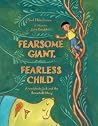
Review: Fearsome Giant, Fearless Child: A Worldwide Jack and the Beanstalk Story

Fearsome Giant, Fearless Child: A Worldwide Jack and the Beanstalk Story Fearsome Giant, Fearless Child: A Worldwide Jack and the Beanstalk Story by Paul Fleischman
My rating: 2 of 5 stars

Doesn't quite live up to the delight that is Glass Slipper, Gold Sandal: A Worldwide Cinderella . I suspect that Fleischman wanted to create a boy-oriented equivalent for those who won't buy "princess" stories for boys, and as a result this tale feels a little more cobbled together than GSGS.

I was particularly thrown twice: first, when some of the "fearless child"'s siblings popped into the story apparently along for the ride instead of waiting back home for the child's triumphant return--I even checked to be sure I hadn't missed a page; and second, at the end when a princess mentioned nowhere else wishes for an inch-tall character to become average-height, implying a romantic ending that doesn't quite fit with the "child" theme.

It was also a little disappointing that "fearless child" is genderless and the introduction mentions "Molly Whuppie", but there didn't seem to be a girl child in the mix. Granted, there's no reason why most of the children pictured couldn't just as easily be boys as girls, but that does require a bit more imagination.

Paschkis's illustrations are, as always, absolutely stunning. I wish I had my copy of GSGS with me for comparison, but it looks like she again looked to the local cultures of the stories for inspiration. This works better with the versions of the stories not set in northern and central Europe, which have more distinct styles and settings than, say, England, France, Germany, and Denmark do. Perhaps true to its melting pot/tossed salad nature, the full-page spread inspired by a U.S. version of the story looks more like a mix of a couple styles than anything really distinct. I guess I should count my blessings that the page wasn't nationalistic red-white-and-blue!

A decent story and a beautiful book, but not one I feel compelled to save for my fairy tale picture book collection.

View all my reviews

Saturday, September 21, 2019

Review: Stargazing

Stargazing Stargazing by Jen Wang
My rating: 4 of 5 stars

Not just charming, but emotionally and socially profound without ever seeming to be so. It's astounding how many social themes Wang covers with the warm and colorful patchwork quilt of the story--like a cat rolled up underneath, unless you're looking out for them you probably won't even notice they're there until you sit on them. And sit on them you should--this is a definite read-it-twice, not just for the art but also for the nostalgic (and less-than-nostalgic) reminder of the simultaneously simple and complicated world of friendships and family relationships at the end of childhood. This book is probably a keeper for me--which is both good and bad, since my graphic novel shelf is now officially overflowing.

If This Was Our Pact and Stargazing are both nominated for Goodreads choice awards (as they should be!) I have no idea what I'm going to do!

View all my reviews

Wednesday, September 4, 2019

Review: Finding Baba Yaga

Finding Baba Yaga Finding Baba Yaga by Jane Yolen
My rating: 3 of 5 stars

Quick read for my subway ride while I figured out how to download my next book. I'm sometimes skeptical of books in verse, and the "chapters" in this one were a bit hit-or-miss for me. Most were pretty much there to move the plot along, so not a ton of introspection from the main character.

Things get more fairy-tale-like as the book progresses, though with clever ties to the modern world to ground the reader--or perhaps confuse them? It's a little too fantasy to be magical realism. I would have liked a little more about the Baba, and perhaps a few more realistic anchors in the almost full-on-fantasy climax. But still, enjoyable with some real gems in the text.

Anyway, it's such a short book that I'd recommend you take a little time to read it, if you're curious.

Quote Round-Up

p. 21) Sometimes a bad word
is punctuation to a bad day.

p. 23) Angels are always clean.
Through the bubbles I ask:
What about feather mites?

p. 48) This is a place of correspondence,
perpetual conversation,
letters written in the air.

River asks a question,
rock asks one back.
Aspen asks birch, birch asks
bracken, bracken asks earth,
earth holds all answers
tight against her breast.

p. 85) Cauldron: I just love this whole poem/chapter for subverting fairy tale tropes with modern conveniences, but also pointing out both that there are magical things in our mundane world, and that things we now consider magical may once have been mundane.

p. 103) ...both so engrossed
in looking at themselves
looking at themselves.
Strikes me as pretty relevant to our social media-obsessed culture. Just thinking about myself, aren't we always eager to see who has been looking at our posts, and aren't we then more likely to look at and respond to theirs in return? We appreciate people who appreciate us. This can be a good and important thing, but the way it's happening in the Baba's house is much like some unhealthy relationships that might form either because of social media or in young people, like Vasilisa.

p. 119) Like the piano player, I have memory
in my fingertips. I watch words spill out
creating worlds, inventing colors,
bridging generations.
...
...the memory of creation is here
in my fingers, as they hold fast
to the feather weight
of Baba Yaga's pen.

p. 125) Baba Yaga swears at objects...
... She doesn't swear at people.
That's what spells are for, she says
as she teaches me the words.
I've never heard such a good summary of my personal philosophy of swearing. It always seemed kind of stupid, to not mind swearing in most cases when it's at objects or as grammar, but to be deeply uncomfortable when swearing becomes weaponized in a specific attack. But hat's how I feel, and I guess I might not actually be alone.


View all my reviews
Sunday, August 25, 2019

Review: Queer: A Graphic History

Queer: A Graphic History Queer: A Graphic History by Meg-John Barker
My rating: 2 of 5 stars

Gosh darn it, I did not want to rate this book so lowly, but it's entirely my fault. I read Erica Moen's glowing review of this book all the way back in 2016 and I guess I forgot (a lot of) the details over time, because I went into this book expecting something very different from what it is.

Based on that subtitle, "A Graphic History", I anticipated a comic-style format introduction to the history of queerness, of being queer, in society throughout history. Instead, Barker and Scheele give us a crash course in queer theory, largely as an academic discipline with only a side order of on-the-street LGBT+ feelings about some ideas--such as the changing perception of "queer" as identity, slur, and reclaimed term.

The format is very different from what I expect when I see the word "graphic"--not panels, but large illustrations that take up most of the page, with the explanatory text shoved up at the top and the bottom in regular font. The illustrations are occasionally helpful illustrations of abstract concepts--and there are a lot of abstract concepts--but they're often just pictures of critical theorists, and these pictures are recycled any time these theorists come up. I might not critique that in a book more like
The Cartoon Introduction to Economics, but in that book there more small pictures breaking down and illustrating concepts step-by-step. Queer, while it has the significant benefits of being concise and friendly-looking, does not take advantage of the illustrated format. Even with just a few paragraphs a page, I found my brain floating in space with the kind of "mind blown" feeling that's more like "exploded into bits" than "expanded understanding."

In other words, this book requires work. Not a problem, just waaaaay out of left field compared to what I expected.

Now that I've adjusted my expectations, I'm going to go back and start again. A chief and--I cannot stress this enough--significant strength of this book is how very concise it is. I can tell that these concepts, as difficult as I may find them on an evening where I wanted something lighter, have been boiled down to the basis. I found the first third of the book and approachable and friendly walk through of more basic concepts, like intersectionality. It was only when we started wading into the weeds of which academic/thinker said what that it started feeling really dense, at which point the conciseness was what saved me from being totally lost.

So I do recommend this book--but only if you, unlike me, do your research and know what you're getting into. Fortunately I got lucky and found my copy on the $1 cart at Strand, so I feel like I got a great deal for what is, essentially, a light-but-meaty academic book.

(Here's another case where I'm not sure what to do about the star rating. The two is for me, personally, not for the quality of the book itself.)

((I'm so far behind in reviews... Might just have to do ratings for some of them, sadly.))

View all my reviews

Friday, August 16, 2019

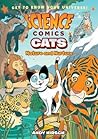
Review: Science Comics: Cats: Nature and Nurture

Science Comics: Cats: Nature and Nurture Science Comics: Cats: Nature and Nurture by Andy Hirsch
My rating: 4 of 5 stars

Absolutely essential reading for anyone who has or loves cats! I've lived with them for most of my life and I still learned tons.

This comic isn't just a fact dump; we follow the story of Bean, a homeless kitten turned internet celebrity, as she explains how her rise from survival to super-stardom couldn't have happened without her keen predatory instincts (nature) and ability to adapt to social environments from solitude to kitty crowds to beloved pet (nurture). It's a super cute way to get tons of information--and answers to so many questions I've had over the years but had just written off as adorable, inexplicable quirks.

For those of you more canine-inclined, Andy Hirsch has also done a Science Comic about dogs. I haven't read that one, but I'd been looking forward to Cats ever since it first came up in the metadata audit seven months ago. I am delighted to say that it's so much more interesting and wonderful than I even expected. Go forth and learn!

View all my reviews

Tuesday, August 13, 2019

Review: Journey Into Mohawk Country

Journey Into Mohawk Country Journey Into Mohawk Country by George O'Connor
My rating: 2 of 5 stars

A pretty cool concept for a graphic novel: take a real historical text and bring it to life. In this case, O'Connor chose a 17th-century Dutchman's journal of his trade visit with some tribes in upstate New York. It seems an odd choice at first, because the journal is, well, pretty boring if you aren't a historian. Many days are much like the others: walking, cold, bedding down at night; or stuck at one village because of snow. On the other hand, this gave O'Connor plenty of room to play with and interpret the events as he wished--the lack of details was a blank canvas...er, page.

This is an excellent opening for both an artist and a historian to play. Details that would require an entire museum exhibit or text-only book can be compressed between two covers when there are images and actions to support a story. Adding literal as well as metaphorical color to dry documents can draw in readers who might not otherwise give old pamphlets like these a chance, and reviving them so creatively ensures that the text will have far more readers that it ever would if it had either been sitting in an archive or just digitized and printed for a narrow audience of researchers. As a publisher, archivist, librarian, and English major by training, practice, and passion...that's pretty freakin' awesome!

However, that "blank page" was also part of the problem for me, in a way. There's really not much grounds to call this anything but historical fiction, because when we get emotions or feelings or any kind of visual information, it's entirely from O'Connor, who didn't abridge the text in any way. I have no problem with historical fiction, but juxtaposing a primary source with something so far removed that I have no idea how many of the visual details are accurate makes me a little uncomfortable. For three examples:

1) Early on, the travelers come across a tent (?) with women in it. For some reason, these women are naked. No other women in the book are naked when they're inside. I have no idea at all whether this is based on historical fact or completely made up to support an ensuing visual gag.

2) The climax of the trading mission takes place entirely off screen while we watch another member of Van den Bogaert's party having fun with an entirely made-up companion. It would have been boring to show the final agreement scene--by this point a rehash of previous discussions--but the scenes in the village are entirely invented, with no tie at all to the original. They're interesting, but they also feel out of place and irrelevant to the point of the story/journal.

3) This is the least comfortable to me. O'Connor has Van den Bogaert spotting a mysterious American Indian around him in the woods, usually in creepy settings. Is this man supposed to be a real person? Signs point to no, but it he a vision? There's no apparent reason why Van den Bogaert would be seeing things. Is this mystery man just there to try to give the reader a little suspense, since we're reading through a boring return journey at this point? Is he supposed to be a metaphor for European settlers' fear of American Indians?

Maybe a little commentary on these items, or at least a more robust author/artist's note about his research and historicity vs. invention would have mitigated my feelings.

I usually gush about the art in graphic novels, but for me, this art wasn't much to write home about. It served the purpose: to illustrate. It felt more like the kind of simplified art you used to see in the comics pages of newspapers (*sob*) than a work of art in its own right. For a historical work, I might have liked a few finer details and less comic-y characters. I did notice at least one other reviewer loved the art, so take this as a matter of taste, not critical commentary.

I do think that the idea behind this work--to shed light on archival materials that can potentially tell us so much about the past--is valuable and wonderful. I very much hope that O'Connor and others like him continue to do this work, remixing and making history accessible. Just...maybe with more robust historical notes.

I'm not really satisfied labeling this 2 stars, but Goodreads says 3 means "liked it." I found it fascinating, but can't say I was more than "okay" about it. So if a 3 meant "average", like you'd think it would, then this would be a 3. I'd recommend it to historians with relevant interests, but probably not to others.

... Finally, to comment on the journal/journey...why the heck did anyone think it was a good idea to do this trip in the dead of winter? It was freezing cold, the snow was thick, and everyone at home thought they'd died. Waiting for spring seems like it would have been logical.

View all my reviews
Wednesday, August 7, 2019

Review: The Enchanted Islands: The Galapagos Discovered

The Enchanted Islands: The Galapagos Discovered The Enchanted Islands: The Galapagos Discovered by John Hickman
My rating: 3 of 5 stars

After two Summer Friday visits to the famous Rose Reading Room to read this book, which cannot be checked out of the New York Public Library, I caved and bought my own copy.

This was the only book I could find (without delving too, too deep) about the human history of the Galapagos islands, which were hinted at in The Beak of the Finch (for which I still haven't finished my review...). To be honest, it never occurred to me that anyone had lived there. I just assumed, based on how everyone talks about how the islands are ideal microcosms of evolution, that there was minimal human presence beyond the whaling "post box" and occasional shore parties. This book demonstrates how thoroughly wrong I was.

Hickman is a lively and engaging narrator, mixing breezy stories with measured facts so that even the dullest chapters--oddly, the one about the islands' geopolitical significance in the 19th and 20th centuries--clip right along. This isn't a super-academic text, so there are no notes or references, though there is a bibliography. There are a few pictures as well, though nothing to write home about. It really is Hickman's writing that carries the work, and we're lucky that the only person who seems to have written at any length about the people on the Galapagos seems to have had quite a way with words.

Highly recommended for anyone planning to visit the Galapagos! There's way more to them than the wonderful wildlife.

Quote Round-Up

Chapter 1: The Inca's Tale
I was a bit impressed here with Hickman's handling of the South American aboriginal cultures. Granted, I'm not totally sure if it's his original thoughts or if he's reciting theories he read about elsewhere, but it seems like it would have been easy for a privileged white man in the 80s to either dismiss Incan legends as nonsense or else take them at face value.

p. 35) The Batchelor's Delight...captured [three Spanish ships] without difficulty but, infuriatingly for the gold-hungry pirates, were found to consist of timber, flour and 'eight tons of quince marmalade'.
It should come as no surprise to those who know me that most of my quotes come from the Golden Age of Sail period. That this should include pirates capturing ships full of jam is just wonderful!

p. 40) Few of the buccaneers had very much formal education, but they were usually men of outstanding ability in one field or another, with enquiring minds and keen eyes.
Shout out to all those far-from-stupid pirates (and sailors)! You don't get enough credit as anything but cannon fodder.

p. 59) In 1846...not a single tortoise was left on Charles' Island. It appears that the tortoise also became extinct at about the same time in Jervis and Barrington Islands. Each of the islands, we now know, had a unique subspecies of tortoise. Three of these races were now utterly extinct.
This was horrible to read about. Hickman explains that ships would take 500 to 600 tortoises in their hold at a time for food or export, and says that there 31 ships stopped at Charles Island in one year alone--for a loss of 15,500-18,600! The fact that such observable species went extinct before conservation efforts stepped in flies in the face of everything I thought I knew about the Galapagos.

p. 68) ...Lieutenant Gamble of the Marines, who was to distinguish himself...by successfully navigating a prize vessel from the Marqueses on an epic voyage of thousands of kilometres to the Sandwich Islands (now called Hawaii) with a crew of only two able-bodied men.
Um, what? Where is this story? I want to read it!

p. 62-69) No specific quotes here, but the adventures of Captain Porter of the U.S.S. Essex sound an awful lot like the movie Master and Commander: stretched his orders to hang around Brazil in order to go around Cape Horn to the Galapagos, encountered British whalers, took prizes/captives by disguising his ship, divided his crew to take ships to Valapraisio, had one precocious "captain" who was only a 12-year-old midshipman...

p. 72) In 1825, Captain Benjamin Morrell described witnessing the eruption of Narborough/Fernandina Island's volcano: "The Tartar's anchorage was about ten miles to the northward of the mountain, and the heat as so great that the melted pitch was running from the vessel's seams and the tar dripping from the rigging... The mercury continued to rise till four p.m., when the temperature of the air had increased to 123 degrees, and that of the water to 105 degrees."
I can't even imagine how absolutely terrifying this must have been in a *wooden* ship! And I'm amazed none of the men died from heat exhaustion--or maybe that just wasn't in the quoted excerpt.

p. 93) Darwin was not the first visitor to be provoked to speculation by what he saw... The fact that these question occurred to others before Darwin is confirmation that these almost empty heaps of lava in the Pacific contain evidence of evolution in forms which are easier for men to understand than anywhere else.
Some of Hickman's sources tiptoe right up to the edge of making Darwinian statements--only to back down at the last minute and say they'll leave those speculations to the scientists. Really fascinating stuff!

Chapter 15: Murder in Paradise
This chapter, about a few eccentric people who lived on one of the near-desert islands, is absolutely bonkers! I just wish Hickman had this kind of detail about all the events on the Galapagos.

p. 129) People were aware of the threat to the ecology of the islands but the concept of environmental conservation was still restricted to a few zealots... Meanwhile, continued effort to create settlements on the islands and capitalize on their supposed economic resources led to the introduction of still more alien animals and plants which multiplied the threat to indigenous species.
It's amazing how hard people tried to turn a profit of this lump of rock. After reading about their struggles, I think I made a reasonable assumption that anyone who tried would have simply run away at the first opportunity. As the tourist trade and conservation efforts started to rise, the dedication to these settlements just get even more baffling to me. What is the point of sticking it out?

p. 142) No quote, but I was reassured to read that in the 1970s Ecuador established a council to ensure that environmental conservation and human development complemented each other--so at least there was some acknowledgement that the goals weren't exactly aligning without help.

p. 158) I wasn't going to read the unrelated appendix about animals of the Galapagos, but then I finished this book and I still had quite a bit of subway ride left...and it turned out to be pretty interesting, so I did finish it. The extra details about tortoise tracks scraped into lava flows, albatross birds that can barely function on land, and, apparently, the most beautiful seagull in the world, make it worth it. So does this description of an albatross feeding its babies:
Feeds are few, often days apart, but enormous when they occur. One scientist, Bryan Nelson, found that a chick could take over 1.8 kilograms at a single meal lasting only a few minutes. Admittedly at the end of it the fortunate (or unfortunate) offspring, with its bulging belly, could no longer stand on its feet. High-pressure feeding goes on for week after week until, at the end of five months, the downy, chocolate-coloured chick weighs much more than either of its parents.
Albatrosses are apparently the Augustus Gloops of the avian world!

View all my reviews
Tuesday, August 6, 2019

Review: The Professor's Daughter

The Professor's Daughter The Professor's Daughter by Joann Sfar
My rating: 3 of 5 stars

A cute and quirky little graphic novel. On the one hand, I liked how oddball and off the wall a lot of the situations were. On the other hand, there were some unexpected inconsistencies, like (view spoiler). I feel like there could have been just a little more elaboration on the ties that bind Imhotep and Lillian together across the centuries, as well as some hint that (view spoiler). Still, the watercolor (?) art is as dreamy and whimsical as the story.

(I think I did my first read in June, but since I always read graphic novels twice, I'm not going to worry about figuring out to sets of Dates read.)

View all my reviews
Thursday, July 25, 2019

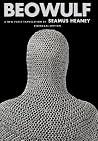
Review: Beowulf: A New Verse Translation

Beowulf: A New Verse Translation Beowulf: A New Verse Translation by Unknown
My rating: 3 of 5 stars

After reading The Mere Wife, of course I had to go back and read Beowulf! I originally read most of it in high school, though I'm pretty sure we left out the digressions. I can still remember the way Ms. Philbin said "Grendel's mother!" and I actually still have her drawing of Grendel in my scrapbook of things-that-used-to-hang-on-my-walls.

It was interesting to have the old English and the modern side by side, as I was occasionally able to pick out words that seemed almost identical to what they are today, or spot similarities. I was annoyed, however, by Heaney's decision to use some of his family's old Celtic words in the text--wasn't the whole point of the translation to make this epic accessible to a modern audience?

Anyway, I couldn't flag passages because this was a library book, so no quote roundup this time. Though I do remember that the phrase "bone-house" was used several times to, it seemed to me, refer to the body, or at least the rib cage. I absolutely love the imagery, so it stuck!

And now back to The Mere Wife for my second reading!

View all my reviews

Sunday, July 21, 2019

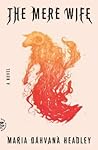
Review: The Mere Wife: A Novel

The Mere Wife: A Novel The Mere Wife: A Novel by Maria Dahvana Headley
My rating: 5 of 5 stars

Read this. The moment you finish your current book, read this. The language is gorgeous, the suburbs are insidious, the mountain is alive, and everyone is a monster and no one is a monster. I might go 4.5 if I could, since I didn't feel deeply emotionally connected to the characters, but that's how I feel reading most classic books. And this will be a classic, I feel. Students could write finals and theses on this. I was wishing I could whip out my pencil and do my English major exercises followed by a discussion.

It's a super hot day and my brain is fried. And anyway, I have in my bag Seamus Heaney's translation of Beowulf which I intend to start the moment I finish this. Wish I could wait for Headley's upcoming translation, but I'm too impatient--I want to read Beowulf and then come back to read The Mere Wife again.

That, my friends, for me, is the sign of a good novel: a reread.

One thing I loved about this novel was how powerful the women felt. Willa may have had her moments, but even she overcame and took charge. Dina, despite her fears, despite moments on the edge, felt in charge. The mothers, a kind of Greek chorus usher people on and off and about the suburban stage, were a magnificent collective creature, cunning. They felt like Mean Girls, but with far more solid, sink-or-swim bonds.

And the whole text has this magic/dreamy/dream-horror feel about it. It'd definitely not horror in the traditional sense, but so much is subtly horrifying.

Like I said: brain fried, Beowulf waiting. Maybe I'll have some more intelligent comments my second time through.


Quote Roundup

The writing was stunning, but I did still manage to flag a few quotes.

p. 152) He doesn't say anything, but she can feel his thoughts now. They're the thoughts men always have. She's spent her life anticipating those thoughts, working around them, pouring their drinks and patting their shoulders, sewing their buttons on tightly so that they can feel secure when they undo everything. No more of that.

p. 153) There's a long tradition that says women gossip, when in fact women are the memory of the world.

p. 174) Willa wonders if her mother has plans for everyone she's ever met, graphic their futures on some invisible chart. Her mother and women like her are the reason men can live at all, running corporations, announcing wars. Every man has a woman at home, and every woman plots the course of the universe, putting it into his breast pocket, like a note attached to a kindergartner, sending him out into his day.

p. 269) Well-preserved. Oh, we hate that phrase. Are we pickles or are we jam? Are we sour or are we sweet?

View all my reviews

Friday, July 12, 2019

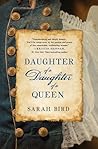
Review: Daughter of a Daughter of a Queen: A Novel

Daughter of a Daughter of a Queen: A Novel Daughter of a Daughter of a Queen: A Novel by Sarah Bird
My rating: 3 of 5 stars

Progress update: I was absolutely loving this book...until characters went completely out of character in order to drive the inevitable romance forward with eye-rolling tropes. Now no one seems to care whether Cathy's caught out. Sigh. I should finish in a day or two. Full review to come then.

~~~

Full Review:

Well, I guess I probably set myself up for disappointment with this one. I just wanted so badly to love it, but in the end it fell into a bunch of corny romance-y tropes that just lost me--though I want to emphasize that said tropes are totally valid and may well be what others absolutely love, so if this sounds like a book you want to read, please don't let me deter you! It's definitely worth it, and I'm still glad I read it.

The writing style was absolutely beautiful, a perfect balance of dialect with the intelligence and wisdom that came from Cathy's upbringing with a remarkable family and an educated father from the North. I appreciated that Cathy never learned to read and write for herself--so often that's treated as a turning point for a character, and as a reader I do understand that, but literacy is also an immense privilege that not everyone can have, and it's important to see that illiteracy and a lack of formal education in no way takes from the worth and strength of remarkable people.

The historicity of people and events seems impeccable, though I don't know enough details about this time period (a big part of my attraction to the book) to know for sure. It seems a bit convenient that Cathy/Cathay's troop (view spoiler), but at least there was still some discussion about the conflicting feelings some soldiers may have felt about their mission.

The book was suspenseful and agonizing in a way that many woman-disguised-as-a-man books are not. It seems that most of those books gloss over the realities of just how dangerous it was to be a woman in the past and the potentially brutal consequences if the character is caught. That agony of always being on the edge of discovery was palpable, and I was glad that my commuting time for reading gave me some breaks.

There was so much to love in the first two thirds of this book...but unfortunately it's time to get back to my disappointment. I can pinpoint the exact moment where everything went off the rails for my personal brand of enjoyment: page 282.

I'd resigned myself early to the fact that we *had* to have a love interest, because of *course* no woman is complete without a perfect man in her life. Cathy's quick bond with a dying soldier in the early pages of the book was believeable enough to me, someone who has made fast--if temporary--friends in unfamiliar new situations. I'd also kind of accepted that it might be possible for Cathy to have a major crush in spite of her constant anxiety about being found out, and to a few stupid actions in the name of love. I thought that Cathy's early, failed encounters with the love interest were realistic responses and well done, so I had hope for a more realistic ending.

Instead, oh boy. I'm going to get really specific with the spoilers here, so stop reading now if you have any interest in this book.

(view spoiler)

Ah well. Let me say again that this book was well worth the read, no matter how annoyed I was during the last third of the book. I learned so much about the "contraband" slaves in the Civil War, the Buffalo Soldiers, and--of course--Cathy Williams. It was a privilege to read about her, even if it was fiction, and I'm glad I did so. I just wish her fictional self could have had less silly romance washing out the tough, never-quit attitude her character had for most of the book.

Quotes & Comments

I didn't take many quotes because I was enjoying the writing and snark so much that I knew I'd never stop once I started. Please read through page 281 1/2!

p. 207: Not a spoiler, but I was interested in Sergeant Allbright's theory of why slavery took off. He theorizes that it's because the presence of water meant bigger crops, which meant more laborers were needed. So out west in the desert, there was no need for slaves. It's an interesting idea, and one that probably only applies to the States, since there were plenty of nomadic, desert-dwelling Biblical slave-holding societies. Of course, Egypt does also fit the pattern. Still...makes me think.

p. 214: (view spoiler)

p. 296: (view spoiler)

p. 365: (view spoiler)

p. 375: Also not a spoiler, and the only quote: "The instant that doing the right thing became a financial advantage, the mob of curs turned righteous..." Yep, ain't that the state of the world. All these corporate diversity campaigns supporting gay rights and hiring athletes of color to represent them only once it presents more of a financial gain than a potential liability. Ugh. Cynical and feels true.

And finally, what is with that useless historical note? If there's hardly anything about Cathy, I want to know everything that we do know!

Anyway, this FINALLY concludes my review. Again, all the reasons this went from awesome to annoying for me may very well be the reasons why others would love this book. The first two third are worth it. Don't let me put you off!

View all my reviews

Saturday, June 29, 2019

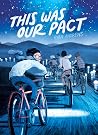
Review: This Was Our Pact

This Was Our Pact This Was Our Pact by Ryan Andrews
My rating: 4 of 5 stars

This graphic novel is absolutely gorgeous and just the right level of dreamy-magical. If you like Hayao Miyazaki's work, you should definitely give this one a go, as it has the same blurred boundaries between the ordinary and the extraordinary. I did my second reading in total awe of the art.

Another blah review because I wasn't able to write this up immediately after finishing...but seriously, I liked this one a lot and highly recommend it.

View all my reviews

Review: Wishtree Costco Edition: Costco Bonus Material

Wishtree Costco Edition: Costco Bonus Material Wishtree Costco Edition: Costco Bonus Material by Katherine Applegate
My rating: 4 of 5 stars

Look, I see the word "charming" thrown around a lot in jacket copy and reviews, but this book was, actually, charming and heartwarming to me. Yeah, it's all neatly wrapped up in a bow in the end, but sometimes that's just how middle grade fiction is. And to be honest, I need a little levity in my life at the moment between the current political situation and end of my master's program.

I loved having the point of view of a long-lived tree, loved the slipped in little bits of nature education (I'm a big sucker for that, it's part of why I enjoyed Catfishing on CatNet so much (and can't wait for it to publish!)), the wonderful personalities of all the animals, and heck, I loved the ultimate solution to the central problem of the narrative. Red's existential threat felt a little overdone, though.

Also, the illustrations are gorgeous. All my respect to Charles Santoso.

There are some publisher-y things I wish I could say about this book that maybe no one else would care about, but I will hold my tong-um, fingers, because yeah, disclaimer, I am a proud employee of the company that published this book.

I used to write such intelligent reviews. *Sigh*...

This is book is cute and clever and any reader above the age range who wants a quick, feel-good read should seriously give this a go.

View all my reviews

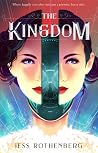
Review: The Kingdom

The Kingdom The Kingdom by Jess Rothenberg
My rating: 3 of 5 stars

This one intrigued me in part because I loved the original version of The Unlikely Death and its questions of ethics. Unfortunately this YA book didn't go quite that deep--it was definitely reaching for bigger concepts, but just didn't quite get there. Still, the concept was interesting, the (clearly) Disney-esque park was amazingly described in all its disbelief-defying glory.

This was a fun, quick read, but one that does require a good bit of suspension of disbelief. The logic of the park starts breaking down pretty quickly if you think about it: (view spoiler)

If anything, I would have liked even more description of the Kingdom. We have no real sense of how long the fantasists have been around, how fashions in the park might have changed. What does Ana remember? It would have been interesting to know more about their dresses and merchandising, and especially to have a "who's who" so we can tell the sisters apart and know what countries/regions they represent. Nia and Eve had their special performances, but what is Ana's? I was also a little disappointed that it didn't end up being Ana on the cover. I was imagining her kind of like Disney's Mulan and then out of nowhere we're told she has red hair. So then I started thinking of her kind of like, well, Ana from Frozen. Not sure if that's intentional or not.

An enjoyable light read with some things to think about--if not quite philosophize on--an okay requisite YA romance with, at least, a someone who wasn't white, and

View all my reviews

Thursday, June 27, 2019

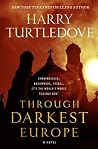
Review: Through Darkest Europe

Through Darkest Europe Through Darkest Europe by Harry Turtledove
My rating: 2 of 5 stars

I give up. I can't take it anymore. I really, really wanted to like this one because I've heard such good things about Harry Turtledove, but it took 75 pages for anything to happen. By page 158 I just don't care about any of the characters and there doesn't seem to be any kind of plot in motion, so I'm not going to keep beating myself up about this.

I love the concept behind this book, but I really need a plot and characters to structure it. We're given so little information to go on about who the characters are--except that Dawud is Jewish, a fact that we are not allowed to forget for more than a few paragraphs--that I just have no emotional investment in them.

Most annoying to me, though, is the style of writing. Something finally happens but then we have to have a full paragraph of Khalid thinking about how things are different in the Maghrib from how they are in Italy. This sometimes even interrupted action so that I forgot what was happening! The text is just so self-aware and points out every single instance where things would be different in the sane, safe Muslim world. I just think that most readers would be smart enough to guess some of these things on their own, without needing them highlighted every single time it happened. It's like the main character is mainsplaining everything to me.

I'm not going to give up on Harry Turtledove--he's written a lot of things that sound interesting--but am calling Through Darkest Europe quits. On to something with plot and action!


Quotes & Notes

None of these are spoilers, they're all just little incidental things.

p. 87 - There's no way on earth that smallpox scars would be mistaken for acne.

p. 111 - I found it interesting that Turtledove created an Islamic equivalent to Hitler. I actually wish I knew more about this situation, because Hitler arose out of very specific circumstances largely shaped by the post-WWI Treaty of Versailles and the Great Depression, neither of which would have necessarily happened in this world.

p. 153 - They stopped at a little town called Montevarchi for a snack and more coffee. Anywhere in the Muslim world, such a stop would have been as ritualized as a visit to a mosque. One or two of the leading five or six anonymous societies would have sold gasoline. etc...
At first I was intrigued by the idea of these "anonymous societies", thinking that it might be some kind of cultural business difference that Turtledove is speculating might have evolved...but then I realized he was probably trying to say "there was a Macdonalds and a Taco Bell" without referencing specific names.

View all my reviews

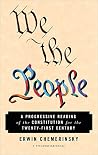
Review: We the People: A Progressive Reading of the Constitution for the Twenty-First Century

We the People: A Progressive Reading of the Constitution for the Twenty-First Century We the People: A Progressive Reading of the Constitution for the Twenty-First Century by Erwin Chemerinsky
My rating: 3 of 5 stars

Not finishing not because it's bad, but because I think I have the gist and now that I'm free of grad school there is SO MUCH FICTION I want to read!

But I've been thinking about this idea a lot lately, that the Constitution ought to be interpreted through the lens of the preamble. Simple but effective. But I just can't take reading all Chermerinsky's depressing examples of where the Supreme Court has failed us...especially as things are just getting worse by the day.

So yeah, I'm on board with you, Chermerinsky, and I think everyone in the Justice Department should read this.

On another note, the quality of the cover is really weird. It feels like it's the consistency of poster board, without any kind of lamination or anything. My copy is way more gross-looking and bent than it should be.

View all my reviews

Friday, June 14, 2019

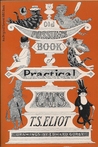
Review: Old Possum's Book of Practical Cats

Old Possum's Book of Practical Cats Old Possum's Book of Practical Cats by T.S. Eliot
My rating: 3 of 5 stars

Just some good fun and levity during the hellish end of my master's research project. I'd known "The Naming of Cats" for years, and recited it to my future in-laws over the holidays, and it was about darn time I read the whole thing.

Also, fun fact, I'm pretty sure my aunt named her cat Eliot in honor of the author. Yeah, my family's awesome.

Again, I forget when I actually read this.

View all my reviews

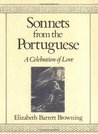
Review: Sonnets from the Portuguese

Sonnets from the Portuguese Sonnets from the Portuguese by Elizabeth Barrett Browning
My rating: 3 of 5 stars

No time for proper reviews right now, as I'm at the end of my last class of grad school and I have a huge pile of short books I've snuck in since February that I need to rate.

While I don't know Barrett Browning's whole story, I do find what I know to be quite meaningful to me. I appreciated the slow progression of the poems from disbelief to love, with all the confused and delightful nuances in between. Yes, I did find myself loving over-quoted sonnet number 14, and we may even read it at our wedding (nothing's settled). But again, I find the touch of melancholy and the knowledge that it was so successfully overcome particularly apt in our case.

I also, to my surprise, very much liked sonnet 6. It really doesn't hold up under a feminist reading--"I feel I shall stand / henceforward in they shadow"--but the overall point of the poem, that no aspect of her life will be untouched by her lover going forward, is beautifully expressed: "What I do / and what I dream include the, as the wine / must taste of its own grapes." If it weren't for that last religious line, I might go for this one for the wedding. Maybe I will anyway...there's nothing to say we can't stop early!

[Dates are a total guess because I totally forget.]
[I almost feel guilty posting this lame review to my feed and forcing people I know to see it.]

View all my reviews

Wednesday, January 9, 2019

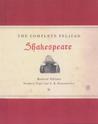
Review: The Complete Pelican Shakespeare

The Complete Pelican Shakespeare The Complete Pelican Shakespeare by William Shakespeare
My rating: 5 of 5 stars

So the way this is going to work is this: Starting now (1/9/19) I'll make a note of which plays I read each year. I like to read at least two, usually in the summer, to keep my hand in. I've done my best to list below the dates on which I think I read the plays before this year, but no guarantees. Someday I'm really going to have to read the poetry instead of just the plays...

Have read:

A Midsummer Night's Dream (2003, 2009, 2013)
The Merchant of Venice (2008, 2009)
The Merry Wives of Windsor (2017)
The Winter's Tale (2017)
The Tempest (2009, 2018)
Henry VI Part I (2016, 2018)
Henry VI Part II (2016, 2018)
Henry VI Part III (2016, 2019)
Richard III (2016, 2019)
Richard II (2015, 2018)
Henry IV Part I (2009, 2015, 2018)
Henry IV Part II (2015, 2018)
Henry V (2015, 2018)
Titus Andronicus (2013)
Romeo and Juliet (2004, 2009)
Hamlet (2007, 2009, 2011)
Othello (2009, 2014)
King Lear, 1608 Quarto & 1623 Folio (2018)
Macbeth (2006, 2007, 2009, 2013, 2017)

View all my reviews