
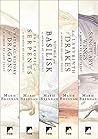
 The Complete Memoirs of Lady Trent Series: A Natural History of Dragons, The Tropic of Serpents, The Voyage of the Basilisk, In the Labyrinth of Drakes, ... Sanctuary of Wings by Marie Brennan
My rating: 4 of 5 stars
View all my reviews
Dang it, I lost my review. That's what I get for stepping away from my computer overnight in mid-review.
Well, the major point was that I felt it was both simultaneously too short--because I thoroughly enjoyed it--and too long. Brennan's worlds feel so rich and colorful, to say nothing of Isabella. Brennan's ability to capture a setting with all the senses is so brilliant that at times I think it may have overwhelmed some of the personalities of background characters. I was also impressed with how much was packed in plot-wise without feeling rushed, at least until the end of the last book.
So, why did I think the series was too long? The fourth book felt a little slow, less world-building-y, and predictable until (view spoiler), and the fifth book took a little longer to get through the winter than I might have wished. Probably if I'd read the books as they published instead of all at once I would have been swept up each time. Actually, I probably wouldn't have gone past the first book, what with my aversion to getting involved with series. So for that reason, I'm glad I only found this series when the last book published.
The books also follow Victorian travel-writing conventions almost to a fault: we have little information about "off screen" characters, which became especially frustrating after Isabella (view spoiler). And finally, I actually wished there were a few more details about dragon study. I shed an internal tear every time Isabella referred us to one of her more scholarly works.
Once again, I am behind on reviews, so I will skip to the quotes and move on. I did read this on a tablet, since I didn't want to take four books with me on my honeymoon, so I don't know what those page counts are based on, as there isn't a print omnibus edition.
QUOTE ROUNDUP
Bursting with spoilers, folks. Read on at your own risk.
Book 2: The Tropic of Serpents
p. 380) The Moulish have few possessions, and little concern for personal property as most of us see it. Their way of living neither permits it nor derives much benefit from it. To own more than you can carry is folly; you will have to abandon it when the camp moves. But most of the things you own--if the "you" in this instance is Moulish--are easily replaced anyway, so their abandonment is no great loss. To try and hoard more than those around you have is a grave insult to social harmony and, I think, to the spirits; it invites ridicule from your fellows and, if that fails, more aggressive methods of forcing you to share. From this the Moulish get their reputation as thieves, but that word belongs to a different world.
See? A fascinatingly different culture for us 'Muricans (though slightly familiar from my anthropology class) with a healthy trace of social commentary for the reader. Brennan is brilliant at this.
p. 386) All those of a given age group within the camp are brothers and sisters, as all those above them are mothers and fathers, or (if older still) the camp's elders.
This is kind of community sounds like a dream, to me.
p. 446) "We have the forest. You are villagers, and our home will eat you."
Wickedest mic drop ever.
p. 491) Despite the unsightly scar on my arm, there was a part of me that thought in delight: I've been bitten by a dragon!
Have I mentioned that I love Isabella?
Book 3: The Voyage of the Basilisk
p. 590) If I had been outrageous on previous expeditions, I found myself surprisingly reluctant to behave in such ways in front of my son. The nobler part of me said that I did not want to set a bad example for him. The selfish part said that I did not want him to think less of me. But which sort of mother would I rather be? The sort who did not go swimming without a proper costume--which in those days consisted of voluminous pantaloons and a knee-length overdress, all in a stiff fabric which would not cling when wet--or the sort who did what she had sailed halfway around the world to do?
"Very well," I said. "Let us go swimming with dragons."
p. 674)(view spoiler)
p. 678) It has been so very long since there was any satisfying scandal about me. I find that respectability grows wearisome after a time, when one is accustomed to being a disgrace.
Book 4: In the Labyrinth of Drakes
p. 841) "Umm Yaqub" was my appellation there: parents are commonly known as the mothers and fathers of their children, and "Yaqub" is the Akhian form of "Jacob."
I loved this detail...and the thought that parents can, essentially, choose their own names when they choose their child's.
p. 896) My outraged squawk startled lizards back into the rocks. "It was not a love note!"
"From you? 'A piece of research material' is as good as a lock of your hair, tied up in a scented ribbon."
I may have mentioned that I love Isabella, but I also love her brother Andrew.
p. 897) "Ah yes," I said ironically. "I have made myself exceptional. It is a wonderful game, is it not? Because I am exceptional, anything I achieve does not reflect on my sex, for of course I am not like them. Strange, though, how that division seems to vanish when we are speaking instead of my shortcomings. Then I am a woman, like any other."
p. 910) There were descriptions of my beauty that likened me to a camel--a high compliment in that society, but in my case both unfounded and not at all an aesthetic I could comprehend.
Not quite sure why I found so many quotes in book 4, when I said it was the one I found slowest. Weird.
p. 927) The pronoun pulled me up short. "She? Your physician is a woman?"
Mahira looked scandalized. "Do you think I would allow a man to examine my body?"
When she put it that way, I could hardly say that I took it for granted. As some of my readers may know, the first university in Akhia was founded by a woman--the mother of one of the caliphs--and apparently she had been in favor of training women physicians, so as to uphold propriety while also caring for the patient's health.
If only people had thought that way in the real world...
p. 955) There is a proverb that says, To a man with a hammer, everything looks like a nail. If I had a gun, it would shape my thinking; the violent response would always be there.
Say it louder for the 2nd Amendment defenders in the back, Isabella!
p. 968) (view spoiler)
Book 5: Within the Sanctuary of Wings
p. 1080) The Mrtyahaima proper lay behind, beyond my vision, rising even higher than I could imagine. Had I seen what I faced while still in Parshe...I believe I would have continued, for my life has been a recurrent tale of my failure to truly understand my peril until it is too late for me to turn back. But I cannot be certain.
p. 1102) "No." Thu sat very upright, then said in a rush, "She wants to know if all four of us are your husbands."
I read about this in my anthropology class: a researcher wrote about a Himalayan culture in which several brothers would marry one woman to avoid splitting up inherited land. Pretty sure it was debunked, but it was fun to see it in here!
p. 1112) A part of my mind was constantly examining my research, asking at every turn, And what else? It was a peculiar feeling. On the one hand, I lamented the loss of my girlish glee, the sense that it was enough simply to learn a new thing and record it for other people to learn. On the other hand, it was also exhilarating, for I was challenging myself to look further, to think harder, to fit what I saw into a larger picture and then tease out its implications.
p. 1160) In my defense I can only say that I had spent my entire tenure in that village either unconscious, in hysterics, or reeling from the flood of new information; and as a consequence, I had the attention span of a gnat: no sooner did I begin pondering one aspect of the puzzle than some equally interesting angle distracted me.
p. 1171) It was hard enough when I must explain myself in my native tongue; in Draconean, I could barely string together an entire sentence that was not about yaks.
VOCABULARY
I used to keep track of new words I learned in each book (even if I could figure it out with context)...at least until I started reading on the subway and pulling out a pencil meant I might elbow someone. It didn't occur to me until near the end of book three that it's much easier to mark words on a tablet.
Definitions are from my old friend Merriam-Webster (okay, online) unless otherwise noted.
p. 735) caeliger - Fortunately, this one's so important to the book that there was an illustration, otherwise I might have been totally lost. Unfortunately, I'm also skunked...that is to say, I have the illustration but I'm tired so I'm not going to look anymore. Gosh I love doing vocabulary for myself instead of school! (Also, fun fact, if Brennan invented this word for her books, in Latin "caeliger" is an adjective that means "heaven-supporting" [at least according to Wiktionary]).
p. 775) lapidary - I kind of figured this one out from context, but its "a cutter, polisher, or engraver of precious stones"
p. 801/1080) propitiate - "To gain or regain the goodwill or favor of; appease"
p. 805) alluvial -
1. Unhelpful: "relating to, composed of, or found in alluvium"
2. More helpful: "clay, silt, sand, gravel, or similar detrital material deposited by running water"
p. 806/907) stelae/stela - "a usually carved or inscribed stone slab or pillar used for commemorative purposes" (the first is pural)
p. 867) bivouac - "a usually temporary encampment under little or no shelter"/"for a night"
p. 897) onager - "an Asian wild ass (Equus hemionus onager)". Feast your eyes.
p. 1035) developmental lability - In Brennan's world, I took this to refer to the fact that dragons can change physiologically simply by changing the circumstances of the eggs, the way crocodiles and alligators can change the sex of their offspring by adjusting the temperature in their nests. I was getting a lot of technical papers when I looked up the phrase, but lability is, broadly, "readily or continually undergoing chemical, physical, or biological change or breakdown : UNSTABLE" or "readily open to change."
p. 1046) cosh - I haven't known what this is since I first read it in Artemis Fowl when I was about nine. Merriam-Webster isn't exactly enlightening: "a weighted weapon similar to a blackjack." Thanks, I have no idea what a blackjack is. Duck Duck Go image searches suggest it's something like a small billy club: smooth, polished, and rounded on the end instead of spiky like a medieval weapon.
p. 1056) synedrion - I'd rumbled sometime during The Voyage of the Basilisk that Isabella and Skirland were Jewish or Jewish-inspired. Looks like "synedrion" is the Greek version of the Hebrew "sanhedrin", and it's an advisory council. In Greek, one if its first uses was for Alexander the Great's advisers. Brennan uses it as the rough equivalent of Britain's Parliament.
p. 1062) rapacity -
1. Unhelpful: "the quality of being rapacious"
2. More helpful: "always wanting more money, possessions, etc.; wanting more than is needed or deserved"
p. 1084) alpenstocks - "a long iron-pointed staff used in mountain climbing" (Wow, I was picturing a pickax...)
p. 1111) eyass (Merriam-Webster says "eyas") - "an unfledged bird, specifically a nestling hawk"
p. 1115) col - "saddle". Wikipedia elaborates, "In geomorphology, a col is the lowest point on a mountain ridge between two peaks. It may also be called a gap." A gap. Thanks, thanks a lot for that, Brennan. I thought it was the opposite: a hill in the middle of a dip.
p. 1118) cirque [Context: Our initial interest lay in a valley below, the cirque between two aretes or ridges...] - "a deep steep-walled basin on a mountain usually forming the blunt end of a valley"
p. 1118) aretes - "a sharp-crested ridge in rugged mountains"
p. 1137) hessian (cloth) - "chiefly British: burlap". That's a lot less romantic than I thought. I was imagining fine cloth.
p. 1140) obligate [Context: a large population of obligate carnivores] - Well, my dictionary app doesn't have it, but I'm going to assume that an "obligate carnivore" is a hypercarnivore: like cats, they can really only eat meat, without dipping into omnivore territory.
p. 1177) clerestory - "the upper part of a wall that rises above a roof and that has windows; gallery". Check out Wikipedia for visuals.
p. 1180) debouching [Context: The corridor led me a short way before debouching into a smaller room.] - "to march out into open ground; emerge, issue". How's that SAT vocabulary for you? I would've just said the corridor opened into a smaller room, but I guess "debouching" is more fun.
p. 1204) potentate - "ruler, sovereign; one who wields great power or sway"

No comments:
Post a Comment