Sunday, August 25, 2019

Review: Queer: A Graphic History

Queer: A Graphic History Queer: A Graphic History by Meg-John Barker
My rating: 2 of 5 stars

Gosh darn it, I did not want to rate this book so lowly, but it's entirely my fault. I read Erica Moen's glowing review of this book all the way back in 2016 and I guess I forgot (a lot of) the details over time, because I went into this book expecting something very different from what it is.

Based on that subtitle, "A Graphic History", I anticipated a comic-style format introduction to the history of queerness, of being queer, in society throughout history. Instead, Barker and Scheele give us a crash course in queer theory, largely as an academic discipline with only a side order of on-the-street LGBT+ feelings about some ideas--such as the changing perception of "queer" as identity, slur, and reclaimed term.

The format is very different from what I expect when I see the word "graphic"--not panels, but large illustrations that take up most of the page, with the explanatory text shoved up at the top and the bottom in regular font. The illustrations are occasionally helpful illustrations of abstract concepts--and there are a lot of abstract concepts--but they're often just pictures of critical theorists, and these pictures are recycled any time these theorists come up. I might not critique that in a book more like
The Cartoon Introduction to Economics, but in that book there more small pictures breaking down and illustrating concepts step-by-step. Queer, while it has the significant benefits of being concise and friendly-looking, does not take advantage of the illustrated format. Even with just a few paragraphs a page, I found my brain floating in space with the kind of "mind blown" feeling that's more like "exploded into bits" than "expanded understanding."

In other words, this book requires work. Not a problem, just waaaaay out of left field compared to what I expected.

Now that I've adjusted my expectations, I'm going to go back and start again. A chief and--I cannot stress this enough--significant strength of this book is how very concise it is. I can tell that these concepts, as difficult as I may find them on an evening where I wanted something lighter, have been boiled down to the basis. I found the first third of the book and approachable and friendly walk through of more basic concepts, like intersectionality. It was only when we started wading into the weeds of which academic/thinker said what that it started feeling really dense, at which point the conciseness was what saved me from being totally lost.

So I do recommend this book--but only if you, unlike me, do your research and know what you're getting into. Fortunately I got lucky and found my copy on the $1 cart at Strand, so I feel like I got a great deal for what is, essentially, a light-but-meaty academic book.

(Here's another case where I'm not sure what to do about the star rating. The two is for me, personally, not for the quality of the book itself.)

((I'm so far behind in reviews... Might just have to do ratings for some of them, sadly.))

View all my reviews

Friday, August 16, 2019

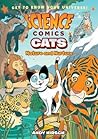
Review: Science Comics: Cats: Nature and Nurture

Science Comics: Cats: Nature and Nurture Science Comics: Cats: Nature and Nurture by Andy Hirsch
My rating: 4 of 5 stars

Absolutely essential reading for anyone who has or loves cats! I've lived with them for most of my life and I still learned tons.

This comic isn't just a fact dump; we follow the story of Bean, a homeless kitten turned internet celebrity, as she explains how her rise from survival to super-stardom couldn't have happened without her keen predatory instincts (nature) and ability to adapt to social environments from solitude to kitty crowds to beloved pet (nurture). It's a super cute way to get tons of information--and answers to so many questions I've had over the years but had just written off as adorable, inexplicable quirks.

For those of you more canine-inclined, Andy Hirsch has also done a Science Comic about dogs. I haven't read that one, but I'd been looking forward to Cats ever since it first came up in the metadata audit seven months ago. I am delighted to say that it's so much more interesting and wonderful than I even expected. Go forth and learn!

View all my reviews

Tuesday, August 13, 2019

Review: Journey Into Mohawk Country

Journey Into Mohawk Country Journey Into Mohawk Country by George O'Connor
My rating: 2 of 5 stars

A pretty cool concept for a graphic novel: take a real historical text and bring it to life. In this case, O'Connor chose a 17th-century Dutchman's journal of his trade visit with some tribes in upstate New York. It seems an odd choice at first, because the journal is, well, pretty boring if you aren't a historian. Many days are much like the others: walking, cold, bedding down at night; or stuck at one village because of snow. On the other hand, this gave O'Connor plenty of room to play with and interpret the events as he wished--the lack of details was a blank canvas...er, page.

This is an excellent opening for both an artist and a historian to play. Details that would require an entire museum exhibit or text-only book can be compressed between two covers when there are images and actions to support a story. Adding literal as well as metaphorical color to dry documents can draw in readers who might not otherwise give old pamphlets like these a chance, and reviving them so creatively ensures that the text will have far more readers that it ever would if it had either been sitting in an archive or just digitized and printed for a narrow audience of researchers. As a publisher, archivist, librarian, and English major by training, practice, and passion...that's pretty freakin' awesome!

However, that "blank page" was also part of the problem for me, in a way. There's really not much grounds to call this anything but historical fiction, because when we get emotions or feelings or any kind of visual information, it's entirely from O'Connor, who didn't abridge the text in any way. I have no problem with historical fiction, but juxtaposing a primary source with something so far removed that I have no idea how many of the visual details are accurate makes me a little uncomfortable. For three examples:

1) Early on, the travelers come across a tent (?) with women in it. For some reason, these women are naked. No other women in the book are naked when they're inside. I have no idea at all whether this is based on historical fact or completely made up to support an ensuing visual gag.

2) The climax of the trading mission takes place entirely off screen while we watch another member of Van den Bogaert's party having fun with an entirely made-up companion. It would have been boring to show the final agreement scene--by this point a rehash of previous discussions--but the scenes in the village are entirely invented, with no tie at all to the original. They're interesting, but they also feel out of place and irrelevant to the point of the story/journal.

3) This is the least comfortable to me. O'Connor has Van den Bogaert spotting a mysterious American Indian around him in the woods, usually in creepy settings. Is this man supposed to be a real person? Signs point to no, but it he a vision? There's no apparent reason why Van den Bogaert would be seeing things. Is this mystery man just there to try to give the reader a little suspense, since we're reading through a boring return journey at this point? Is he supposed to be a metaphor for European settlers' fear of American Indians?

Maybe a little commentary on these items, or at least a more robust author/artist's note about his research and historicity vs. invention would have mitigated my feelings.

I usually gush about the art in graphic novels, but for me, this art wasn't much to write home about. It served the purpose: to illustrate. It felt more like the kind of simplified art you used to see in the comics pages of newspapers (*sob*) than a work of art in its own right. For a historical work, I might have liked a few finer details and less comic-y characters. I did notice at least one other reviewer loved the art, so take this as a matter of taste, not critical commentary.

I do think that the idea behind this work--to shed light on archival materials that can potentially tell us so much about the past--is valuable and wonderful. I very much hope that O'Connor and others like him continue to do this work, remixing and making history accessible. Just...maybe with more robust historical notes.

I'm not really satisfied labeling this 2 stars, but Goodreads says 3 means "liked it." I found it fascinating, but can't say I was more than "okay" about it. So if a 3 meant "average", like you'd think it would, then this would be a 3. I'd recommend it to historians with relevant interests, but probably not to others.

... Finally, to comment on the journal/journey...why the heck did anyone think it was a good idea to do this trip in the dead of winter? It was freezing cold, the snow was thick, and everyone at home thought they'd died. Waiting for spring seems like it would have been logical.

View all my reviews

Wednesday, August 7, 2019

Review: The Enchanted Islands: The Galapagos Discovered

The Enchanted Islands: The Galapagos Discovered The Enchanted Islands: The Galapagos Discovered by John Hickman
My rating: 3 of 5 stars

After two Summer Friday visits to the famous Rose Reading Room to read this book, which cannot be checked out of the New York Public Library, I caved and bought my own copy.

This was the only book I could find (without delving too, too deep) about the human history of the Galapagos islands, which were hinted at in The Beak of the Finch (for which I still haven't finished my review...). To be honest, it never occurred to me that anyone had lived there. I just assumed, based on how everyone talks about how the islands are ideal microcosms of evolution, that there was minimal human presence beyond the whaling "post box" and occasional shore parties. This book demonstrates how thoroughly wrong I was.

Hickman is a lively and engaging narrator, mixing breezy stories with measured facts so that even the dullest chapters--oddly, the one about the islands' geopolitical significance in the 19th and 20th centuries--clip right along. This isn't a super-academic text, so there are no notes or references, though there is a bibliography. There are a few pictures as well, though nothing to write home about. It really is Hickman's writing that carries the work, and we're lucky that the only person who seems to have written at any length about the people on the Galapagos seems to have had quite a way with words.

Highly recommended for anyone planning to visit the Galapagos! There's way more to them than the wonderful wildlife.

Quote Round-Up

Chapter 1: The Inca's Tale
I was a bit impressed here with Hickman's handling of the South American aboriginal cultures. Granted, I'm not totally sure if it's his original thoughts or if he's reciting theories he read about elsewhere, but it seems like it would have been easy for a privileged white man in the 80s to either dismiss Incan legends as nonsense or else take them at face value.

p. 35) The Batchelor's Delight...captured [three Spanish ships] without difficulty but, infuriatingly for the gold-hungry pirates, were found to consist of timber, flour and 'eight tons of quince marmalade'.
It should come as no surprise to those who know me that most of my quotes come from the Golden Age of Sail period. That this should include pirates capturing ships full of jam is just wonderful!

p. 40) Few of the buccaneers had very much formal education, but they were usually men of outstanding ability in one field or another, with enquiring minds and keen eyes.
Shout out to all those far-from-stupid pirates (and sailors)! You don't get enough credit as anything but cannon fodder.

p. 59) In 1846...not a single tortoise was left on Charles' Island. It appears that the tortoise also became extinct at about the same time in Jervis and Barrington Islands. Each of the islands, we now know, had a unique subspecies of tortoise. Three of these races were now utterly extinct.
This was horrible to read about. Hickman explains that ships would take 500 to 600 tortoises in their hold at a time for food or export, and says that there 31 ships stopped at Charles Island in one year alone--for a loss of 15,500-18,600! The fact that such observable species went extinct before conservation efforts stepped in flies in the face of everything I thought I knew about the Galapagos.

p. 68) ...Lieutenant Gamble of the Marines, who was to distinguish himself...by successfully navigating a prize vessel from the Marqueses on an epic voyage of thousands of kilometres to the Sandwich Islands (now called Hawaii) with a crew of only two able-bodied men.
Um, what? Where is this story? I want to read it!

p. 62-69) No specific quotes here, but the adventures of Captain Porter of the U.S.S. Essex sound an awful lot like the movie Master and Commander: stretched his orders to hang around Brazil in order to go around Cape Horn to the Galapagos, encountered British whalers, took prizes/captives by disguising his ship, divided his crew to take ships to Valapraisio, had one precocious "captain" who was only a 12-year-old midshipman...

p. 72) In 1825, Captain Benjamin Morrell described witnessing the eruption of Narborough/Fernandina Island's volcano: "The Tartar's anchorage was about ten miles to the northward of the mountain, and the heat as so great that the melted pitch was running from the vessel's seams and the tar dripping from the rigging... The mercury continued to rise till four p.m., when the temperature of the air had increased to 123 degrees, and that of the water to 105 degrees."
I can't even imagine how absolutely terrifying this must have been in a *wooden* ship! And I'm amazed none of the men died from heat exhaustion--or maybe that just wasn't in the quoted excerpt.

p. 93) Darwin was not the first visitor to be provoked to speculation by what he saw... The fact that these question occurred to others before Darwin is confirmation that these almost empty heaps of lava in the Pacific contain evidence of evolution in forms which are easier for men to understand than anywhere else.
Some of Hickman's sources tiptoe right up to the edge of making Darwinian statements--only to back down at the last minute and say they'll leave those speculations to the scientists. Really fascinating stuff!

Chapter 15: Murder in Paradise
This chapter, about a few eccentric people who lived on one of the near-desert islands, is absolutely bonkers! I just wish Hickman had this kind of detail about all the events on the Galapagos.

p. 129) People were aware of the threat to the ecology of the islands but the concept of environmental conservation was still restricted to a few zealots... Meanwhile, continued effort to create settlements on the islands and capitalize on their supposed economic resources led to the introduction of still more alien animals and plants which multiplied the threat to indigenous species.
It's amazing how hard people tried to turn a profit of this lump of rock. After reading about their struggles, I think I made a reasonable assumption that anyone who tried would have simply run away at the first opportunity. As the tourist trade and conservation efforts started to rise, the dedication to these settlements just get even more baffling to me. What is the point of sticking it out?

p. 142) No quote, but I was reassured to read that in the 1970s Ecuador established a council to ensure that environmental conservation and human development complemented each other--so at least there was some acknowledgement that the goals weren't exactly aligning without help.

p. 158) I wasn't going to read the unrelated appendix about animals of the Galapagos, but then I finished this book and I still had quite a bit of subway ride left...and it turned out to be pretty interesting, so I did finish it. The extra details about tortoise tracks scraped into lava flows, albatross birds that can barely function on land, and, apparently, the most beautiful seagull in the world, make it worth it. So does this description of an albatross feeding its babies:
Feeds are few, often days apart, but enormous when they occur. One scientist, Bryan Nelson, found that a chick could take over 1.8 kilograms at a single meal lasting only a few minutes. Admittedly at the end of it the fortunate (or unfortunate) offspring, with its bulging belly, could no longer stand on its feet. High-pressure feeding goes on for week after week until, at the end of five months, the downy, chocolate-coloured chick weighs much more than either of its parents.
Albatrosses are apparently the Augustus Gloops of the avian world!

View all my reviews

Tuesday, August 6, 2019

Review: The Professor's Daughter

The Professor's Daughter The Professor's Daughter by Joann Sfar
My rating: 3 of 5 stars

A cute and quirky little graphic novel. On the one hand, I liked how oddball and off the wall a lot of the situations were. On the other hand, there were some unexpected inconsistencies, like (view spoiler). I feel like there could have been just a little more elaboration on the ties that bind Imhotep and Lillian together across the centuries, as well as some hint that (view spoiler). Still, the watercolor (?) art is as dreamy and whimsical as the story.

(I think I did my first read in June, but since I always read graphic novels twice, I'm not going to worry about figuring out to sets of Dates read.)

View all my reviews