Sunday, October 27, 2019

Review: His Hideous Heart

His Hideous Heart His Hideous Heart by Dahlia Adler
My rating: 4 of 5 stars

What a perfectly gloomy, rainy day to post a review of Poe and his devotees.

Quick reminder that, while I work for the publisher of this book, my thoughts and opinions about it are entirely my own.

Okay, so admittedly I picked this one up more because it’s frankly a scandal that I haven’t read more Poe by this point in my literary life—so, success! I’m assuming this book is as much about encouraging enjoyment of classic Gothic horror as it is about entertaining with the retellings, and it worked for me. I’d read the Poe first (trying not to stab people on the subway with my pencil while underlining vocab words) and then read the retelling.

It was a great way to get me started. I remember being frustrated even by stories I enjoyed in high school, like “The Masque of the Red Death”, so knowing I’d have the modern adaptations as breaks helped get me started. And guess what? Surprise, surprise (sarcasm—I really shouldn’t have been), post-English major it is now far easier for me to comprehend what’s going on. Doesn’t mean there isn’t still an unusually high number of words that I don’t understand—hence the subway pencil adventures.

As in any collections, I found some of the adaptations worked better than others for me. A few, like “She Rode a Horse of Fire” (“Metzengerstein”), “Red” (“The Masque of the Red Death”), and even “It’s Carnival!” (“The Cask of Amontillado”) (the last of which I did like) were basically just straightforward modern adaptations of the story. The ones I enjoyed the most had more of a twist to them, like:

>> “Night-Tide”, a story that recast the poem Annabel Lee as a tragic and touching historical love story between two young women who meet at a seaside resort each year

>> “A Drop of Stolen Ink” which put a light sci-fi spin on “The Purloined Letter” and builds a robust, complex world in a short story

>> “Happy Days, Sweetheart”, which recasts “The Telltale Heart” in light of the frustration many women felt in the wake of the 2016 election and that women of color face every day of their lives. The final sentence is an absolutely fantastic sendup of the original story’s end—my eyebrows jumped so high, the in-public equivalent of a jaw-drop!

>> “The Oval Filter”, an adaptation of “The Oval Portrait” that turned Poe’s straightforward and, to me, dull-ish story into a mystery with a, to me, more Poe-ish ending—and which, sadly, may not age well since the “portrait” is now a series of Instagram photos

and

>> “The Murders in the Rue Apartelle, Boracay,” which relocated “The Murders in the Rue Morgue” to an urban fantasy Philippines and gave us a trans protagonist with an unhesitant love interest and an ending that still surprised…if maybe not quite as much as the flabbergasting ending of Poe’s original

And then there was “The Raven (Remix)”, a found poem/short and creepy ghost story created by blacking out, well, almost all of the original poem. I was impressed the author found it there, but also a little put out by how much of the original poem was gone. So mixed feelings on that one.

As for Poe’s stories, well, I’m still going to be a die-hard fan of “The Cask of Amontillado” and “The Raven”—the first for how much is said in so little (I love that we’re never really given a reason why Montresor is getting revenge on Fortunato—Jackson gives us a little more info), and the second for its intricate rhyme scheme and ironic fatalism. I’m not even going to try to defend myself for those cliché reasons to like those two, okay? But I also enjoyed discovering “Hop-Frog” and the first detective story ever, “The Murders in the Rue Morgue” (as delightfully ridiculous as it was).

Now, I do have to admit that Adler’s editing of this collection disappointed me. It seems to me that the whole point of separating the adaptations from the originals might be to whet readers’ appetites for the genre, so that someone reading straight from front to back might venture into the Poe once they completed the retellings. But Poe is not necessarily easy for many people to read; I loved Frankenstein in high school but, at the same time, I struggled with “The Masque of the Red Death”—and this text offers no help whatsoever. Latin and French go untranslated, antiquated and SAT-level vocab goes undefined, and cultural allusions go unglossed.

I was also perplexed by a couple of the story versions selected for printing. “Hop-Frog” seemed to be a 1912 version that had what appears to be a misspelling (three earlier editions had the word “flax” instead of “flu”, which makes more sense to me in context). Only “Hop-Frog” and “The Murders in the Rue Morgue” had a few annotations and one spelling correction/modernization, but those notes were made by previous editors of now-Public Domain collections, not by Adler. The inconsistency between absolutely no helpful notes and a smattering of them in two stories was strange and a bit jarring, especially since there are plenty of Public Domain versions to choose from. [Also, I know it’s not required for Public Domain works, but none of the stories’ sources were cited. C’mon, really?]

So yeah, in my opinion there wasn’t enough heavy lifting on the editing in the Poe part of this collection. Translations of the Latin and French would be, to me, the bare minimum.

But I’m a nerd, and I had a lot of fun annotating my copy with all this info. So…maybe I owe Adler thanks for letting me geek out and look up vocab, forgotten 19th-century writers, 17th century convicts-turned-undercover-cops (seriously, look up Eugene Vidocq, he’s incredible), and Greek mythological figures. (And please don’t tell me I wasted my time doing this because annotated copies already exist. I know. I know.)

I still whole-heartedly recommend this perfect Halloween read for lovers of creepy short stories, Victorian Gothic horror, and, of course, Edgar Allan Poe.


Quote Roundup in order of appearance

I feel horrible saying this, but frankly I thought the very first story, a straight-forward retelling, was the most boring of the bunch. The second, “The Glittering Death” for “The Pit and the Pendulum”, was more of a departure and seemed to sit squarest in the horror genre, but also didn’t do much for me--though the person writing in the New York Times Book Review loved it, so obviously this is a matter of opinion! For me,His Hideous Heart hit its stride with the third story, “Night-Tide”.

p. 59) [A serial killer is on the loose and an FBI officer is telling kids to be prepared.]
“So here’s a little practical advice” …
“Fuck, why don’t we all just lock ourselves in our bedrooms until we’re thirty?” Mark rolled his eyes, seeking our agreement, but we left him hanging.
It wasn’t his fault. He’s gay, but he’s a boy, and he hasn’t heard the exact same advice spewed at him about every activity that might get him out of the house. Going to the mall? Make sure people know where you are! Staying out late? Keep your phone with you at all times! Going to a party? Don’t you dare leave your drink unattended!
There are so many reasons why guys should read this collection as well as girls (okay, mostly because it’s just plain good). No matter how times we women/women-presenting people say this, guys just don’t seem to get it.

p. 65) A vocab word in the modern section! Don’t worry, I’m not going to type up everything (anything) in the Poe part, but for the modern bits…
gelid: very cold, icy.

p. 114) Bottom line: People didn’t like me, and the cruelest twist was that what they didn’t like were the precise qualities that made me worthy of winning.
I…hardly know where to start quoting “Happy Days, Sweetheart". Seriously, just about every other page has a dog-ear. There are so many references to the 2016 election, to the crap that women and especially women of color have to put up with, and then just some great writing. Like Poe did in the original story, Kuehn fits a lot of emotion in a little space.

(view spoiler)

p. 143) More vocab, which I ought to have looked up ages ago.
unseelie: evil and malevolent fairies
seelie: good and benevolent fairies

p. 179) jacquard: fabric with an elaborate pattern made on a jacquard loom (a frickin’ complicated looking thing invented in the 1700s that simplified weaving those complex patterns and apparently used paper punch cards to set the patterns, which makes me think of early computers)

p. 193) I liked the idea behind “The Fall of the Bank of Usher,” but it felt a little rushed at times, like a couple descriptive words were missing, just enough to disorient me. I can’t help but feel that maybe Wilde tried to do a little too much with a little too little space. I think it would have made a better novella.

(view spoiler)

p. 276) …in truth, the characteristics of my beloved, her rare learning, her singular yet placid cast of beauty, and the thrilling and enthralling eloquence of her low musical language, made their way into my heart…
I had so much respect for Poe in this moment. The very first reason the narrator lists for falling in love with Ligeia is her intelligence. Can’t have been very common in the ~1830s!

p. 405) As he spoke, the lady Madeline (for so she was called) passed slowly through a remote portion of the apartment… I regarded her with utter astonishment… Her figure, her air, her features—all, in their very minutest development were those—were identically, (I can use no other sufficient term,) were identically those of Roderick Usher who sat beside me.
I was so excited when I read this to see what someone writing today would do with it. The result wasn’t quite as gender-bending as I’d hoped, but still had a pretty darn good message about identity attached to it.

p. 428) I was astonished by how much the setup for "The Murders in the Rue Morgue” resembled the setup for the Sherlock Holmes stories. One can only wonder whether, if Poe had survived, Aguste Dupin would now be the best-known detective with the most associated film and book adaptations of any fictional hero, instead of Conan Doyle’s creation.

Finally, finally, we reach the end of this epic review:

I was a bit confused by the decision to include “The Murders in the Rue Morgue,” the story that introduced detective Auguste Dupin, after “The Purloined Letter,” one of his later adventures and one that had a far denser and less reader-friendly beginning. I mean, I totally get and agree with wanting to use “The Murders in the Rue Apartelle, Boracay” as the crowning piece of the collection—I would gobble up a whole book set in this world!—but “A Drop of Stolen Ink” is also excellent and wouldn’t be a bad last note. Actually, the final punch of “Happy Days, Sweetheart” would have been a perfect final punch for the whole collection, especially because it’s based on Poe’s most famous tale, “The Tell-Tale Heart”, and the one that gave the collection its title.

View all my reviews

Saturday, October 19, 2019

Review: Tears of the Trufflepig

Tears of the Trufflepig Tears of the Trufflepig by Fernando A. Flores
My rating: 4 of 5 stars

I've wanted to read this ever since I read the title in my report--and Flores did not disappoint. Perhaps not as totally bonkers as I expected, but somehow that made it work even better. It's more fantastic than Robin Sloan's Sourdough but only because the world is slightly different than ours--though realistically so. Realistically enough that I was a bit horrified when I read his description of the border between the U.S. and Mexico, because it sounds much more plausible than a wall.

Also...I think would like a Trufflepig for a pet. (view spoiler)

The language was beautiful overall, though there were a couple places where it felt a bit overwritten...like the very first page, on which Bellacosa "stomped down hard and fine orange dust lifted and formed a ghost in his own image, eager to dance or play cards." Um...what? My brain had to grapple with the idea of a dust cloud in someone's image. Even in a book smacking of magical realism, that didn't quite make sense to me--not least because, as I went on, this kind of unlikely situation and the flowery last phrase of my quote were not typical of the rest of the book.

Flores's environments in southern Texas and northern Mexico are so realistically described that the atmosphere is almost palpable, even the parts that are clearly more on the fantastic side of the divide. That feast of filtered animals--setting aside the disgust that might go with reviving an extinct species only to kill them for food--was delicious.

Also nice was that the women characters had wonderful, colorful personalities even if they weren’t main characters. Fortune tellers, dinner guests and illegal feast emcees, artists and musicians daylighting as waitresses, even the dream-versions of Bellacosa’s wife and daughter felt rounded and interesting as characters in their own right instead of simply as props. No gratuitous sex/love between the main character and inappropriately younger women. Hallelujah!

Despite juggling many moving parts--noir-esque, realistic, fantastic, mystical--Flores managed to bring everything together in a satisfyingly and possibly interpretable conclusion.

It's a bit of a slow start, but I do recommend this book for anyone with a little patience and an appreciation of the weird/magical realistic.

Quote Roundup

p. 36) One more oddball overwriting moment:
The sky grimaced like an old retiree counting change.
The sky grimaced? What is that even supposed to mean?

p. 103) “I’m not a member of the Government Daily or anything like that. I’m a journalist, like R. Murrow, abiding by the Truth-perception standards of the day. … We will have to eat and try everything they serve, no matter how disgusting it is in reality. A high-class affair, in other words.”
Come for the creepy Government vs. “Truth-perception” commentary in our post-factual world, stay for the .01% barbs.

p. 200) “…Sopo had to climb their volcano god Huixtepeltinico and rescue what academics from a certain era referred to as ‘el cerdo reptil’—a term first coined by the Mexican historian Dr. Lazara Carranza, somewhat crudely translated by himself as “the Trufflepig.”
Very crudely. Even I, without a scrap of Spanish beyond “hola” and “gato”, can tell that “el cerdo reptile” has nothing to do with the words “truffle” or “pig”. Probably part of the humor.

p. 216) vocab: capsicum: pepper / tropical American herbs and shrubs of the nightshade family. The context is “they walked into the capsicum fog”, so I can’t say I’m any more enlightened than I was before…

p. 218) No idea why the TV has been called a replica instead. I can kind of understand how “filtering” might be derived from scientific process that we don’t understand, but there aren’t really hints of what makes a “replica” different from a TV.

p. 243-244) The Trufflepig was beginning to disturb Bellacosa. Then, strangely, the creature gave him some kind of assurance. He felt that if a Trufflepig could happen, that anything could happen, and Bellacosa began thinking of it as a kind of Tex-Mex platypus.
Yes, please, I’ll take one.

p. 277) Here’s where we find out how there are two boarder walls and how a third can even be considered: (view spoiler).


View all my reviews

Thursday, October 10, 2019

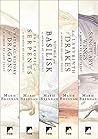
Review: The Complete Memoirs of Lady Trent Series: A Natural History of Dragons, The Tropic of Serpents, The Voyage of the Basilisk, In the Labyrinth of Drakes, ... Sanctuary of Wings

The Complete Memoirs of Lady Trent Series: A Natural History of Dragons, The Tropic of Serpents, The Voyage of the Basilisk, In the Labyrinth of Drakes, ... Sanctuary of Wings The Complete Memoirs of Lady Trent Series: A Natural History of Dragons, The Tropic of Serpents, The Voyage of the Basilisk, In the Labyrinth of Drakes, ... Sanctuary of Wings by Marie Brennan
My rating: 4 of 5 stars

View all my reviews

Dang it, I lost my review. That's what I get for stepping away from my computer overnight in mid-review.

Well, the major point was that I felt it was both simultaneously too short--because I thoroughly enjoyed it--and too long. Brennan's worlds feel so rich and colorful, to say nothing of Isabella. Brennan's ability to capture a setting with all the senses is so brilliant that at times I think it may have overwhelmed some of the personalities of background characters. I was also impressed with how much was packed in plot-wise without feeling rushed, at least until the end of the last book.

So, why did I think the series was too long? The fourth book felt a little slow, less world-building-y, and predictable until (view spoiler), and the fifth book took a little longer to get through the winter than I might have wished. Probably if I'd read the books as they published instead of all at once I would have been swept up each time. Actually, I probably wouldn't have gone past the first book, what with my aversion to getting involved with series. So for that reason, I'm glad I only found this series when the last book published.

The books also follow Victorian travel-writing conventions almost to a fault: we have little information about "off screen" characters, which became especially frustrating after Isabella (view spoiler). And finally, I actually wished there were a few more details about dragon study. I shed an internal tear every time Isabella referred us to one of her more scholarly works.

Once again, I am behind on reviews, so I will skip to the quotes and move on. I did read this on a tablet, since I didn't want to take four books with me on my honeymoon, so I don't know what those page counts are based on, as there isn't a print omnibus edition.

QUOTE ROUNDUP
Bursting with spoilers, folks. Read on at your own risk.

Book 2: The Tropic of Serpents

p. 380) The Moulish have few possessions, and little concern for personal property as most of us see it. Their way of living neither permits it nor derives much benefit from it. To own more than you can carry is folly; you will have to abandon it when the camp moves. But most of the things you own--if the "you" in this instance is Moulish--are easily replaced anyway, so their abandonment is no great loss. To try and hoard more than those around you have is a grave insult to social harmony and, I think, to the spirits; it invites ridicule from your fellows and, if that fails, more aggressive methods of forcing you to share. From this the Moulish get their reputation as thieves, but that word belongs to a different world.
See? A fascinatingly different culture for us 'Muricans (though slightly familiar from my anthropology class) with a healthy trace of social commentary for the reader. Brennan is brilliant at this.

p. 386) All those of a given age group within the camp are brothers and sisters, as all those above them are mothers and fathers, or (if older still) the camp's elders.
This is kind of community sounds like a dream, to me.

p. 446) "We have the forest. You are villagers, and our home will eat you."
Wickedest mic drop ever.

p. 491) Despite the unsightly scar on my arm, there was a part of me that thought in delight: I've been bitten by a dragon!
Have I mentioned that I love Isabella?


Book 3: The Voyage of the Basilisk

p. 590) If I had been outrageous on previous expeditions, I found myself surprisingly reluctant to behave in such ways in front of my son. The nobler part of me said that I did not want to set a bad example for him. The selfish part said that I did not want him to think less of me. But which sort of mother would I rather be? The sort who did not go swimming without a proper costume--which in those days consisted of voluminous pantaloons and a knee-length overdress, all in a stiff fabric which would not cling when wet--or the sort who did what she had sailed halfway around the world to do?
"Very well," I said. "Let us go swimming with dragons."

p. 674)(view spoiler)

p. 678) It has been so very long since there was any satisfying scandal about me. I find that respectability grows wearisome after a time, when one is accustomed to being a disgrace.


Book 4: In the Labyrinth of Drakes

p. 841) "Umm Yaqub" was my appellation there: parents are commonly known as the mothers and fathers of their children, and "Yaqub" is the Akhian form of "Jacob."
I loved this detail...and the thought that parents can, essentially, choose their own names when they choose their child's.

p. 896) My outraged squawk startled lizards back into the rocks. "It was not a love note!"
"From you? 'A piece of research material' is as good as a lock of your hair, tied up in a scented ribbon."
I may have mentioned that I love Isabella, but I also love her brother Andrew.

p. 897) "Ah yes," I said ironically. "I have made myself exceptional. It is a wonderful game, is it not? Because I am exceptional, anything I achieve does not reflect on my sex, for of course I am not like them. Strange, though, how that division seems to vanish when we are speaking instead of my shortcomings. Then I am a woman, like any other."

p. 910) There were descriptions of my beauty that likened me to a camel--a high compliment in that society, but in my case both unfounded and not at all an aesthetic I could comprehend.

Not quite sure why I found so many quotes in book 4, when I said it was the one I found slowest. Weird.

p. 927) The pronoun pulled me up short. "She? Your physician is a woman?"
Mahira looked scandalized. "Do you think I would allow a man to examine my body?"
When she put it that way, I could hardly say that I took it for granted. As some of my readers may know, the first university in Akhia was founded by a woman--the mother of one of the caliphs--and apparently she had been in favor of training women physicians, so as to uphold propriety while also caring for the patient's health.
If only people had thought that way in the real world...

p. 955) There is a proverb that says, To a man with a hammer, everything looks like a nail. If I had a gun, it would shape my thinking; the violent response would always be there.
Say it louder for the 2nd Amendment defenders in the back, Isabella!

p. 968) (view spoiler)


Book 5: Within the Sanctuary of Wings

p. 1080) The Mrtyahaima proper lay behind, beyond my vision, rising even higher than I could imagine. Had I seen what I faced while still in Parshe...I believe I would have continued, for my life has been a recurrent tale of my failure to truly understand my peril until it is too late for me to turn back. But I cannot be certain.

p. 1102) "No." Thu sat very upright, then said in a rush, "She wants to know if all four of us are your husbands."
I read about this in my anthropology class: a researcher wrote about a Himalayan culture in which several brothers would marry one woman to avoid splitting up inherited land. Pretty sure it was debunked, but it was fun to see it in here!

p. 1112) A part of my mind was constantly examining my research, asking at every turn, And what else? It was a peculiar feeling. On the one hand, I lamented the loss of my girlish glee, the sense that it was enough simply to learn a new thing and record it for other people to learn. On the other hand, it was also exhilarating, for I was challenging myself to look further, to think harder, to fit what I saw into a larger picture and then tease out its implications.

p. 1160) In my defense I can only say that I had spent my entire tenure in that village either unconscious, in hysterics, or reeling from the flood of new information; and as a consequence, I had the attention span of a gnat: no sooner did I begin pondering one aspect of the puzzle than some equally interesting angle distracted me.

p. 1171) It was hard enough when I must explain myself in my native tongue; in Draconean, I could barely string together an entire sentence that was not about yaks.


VOCABULARY
I used to keep track of new words I learned in each book (even if I could figure it out with context)...at least until I started reading on the subway and pulling out a pencil meant I might elbow someone. It didn't occur to me until near the end of book three that it's much easier to mark words on a tablet.

Definitions are from my old friend Merriam-Webster (okay, online) unless otherwise noted.

p. 735) caeliger - Fortunately, this one's so important to the book that there was an illustration, otherwise I might have been totally lost. Unfortunately, I'm also skunked...that is to say, I have the illustration but I'm tired so I'm not going to look anymore. Gosh I love doing vocabulary for myself instead of school! (Also, fun fact, if Brennan invented this word for her books, in Latin "caeliger" is an adjective that means "heaven-supporting" [at least according to Wiktionary]).

p. 775) lapidary - I kind of figured this one out from context, but its "a cutter, polisher, or engraver of precious stones"

p. 801/1080) propitiate - "To gain or regain the goodwill or favor of; appease"

p. 805) alluvial -
1. Unhelpful: "relating to, composed of, or found in alluvium"
2. More helpful: "clay, silt, sand, gravel, or similar detrital material deposited by running water"

p. 806/907) stelae/stela - "a usually carved or inscribed stone slab or pillar used for commemorative purposes" (the first is pural)

p. 867) bivouac - "a usually temporary encampment under little or no shelter"/"for a night"

p. 897) onager - "an Asian wild ass (Equus hemionus onager)". Feast your eyes.

p. 1035) developmental lability - In Brennan's world, I took this to refer to the fact that dragons can change physiologically simply by changing the circumstances of the eggs, the way crocodiles and alligators can change the sex of their offspring by adjusting the temperature in their nests. I was getting a lot of technical papers when I looked up the phrase, but lability is, broadly, "readily or continually undergoing chemical, physical, or biological change or breakdown : UNSTABLE" or "readily open to change."

p. 1046) cosh - I haven't known what this is since I first read it in Artemis Fowl when I was about nine. Merriam-Webster isn't exactly enlightening: "a weighted weapon similar to a blackjack." Thanks, I have no idea what a blackjack is. Duck Duck Go image searches suggest it's something like a small billy club: smooth, polished, and rounded on the end instead of spiky like a medieval weapon.

p. 1056) synedrion - I'd rumbled sometime during The Voyage of the Basilisk that Isabella and Skirland were Jewish or Jewish-inspired. Looks like "synedrion" is the Greek version of the Hebrew "sanhedrin", and it's an advisory council. In Greek, one if its first uses was for Alexander the Great's advisers. Brennan uses it as the rough equivalent of Britain's Parliament.

p. 1062) rapacity -
1. Unhelpful: "the quality of being rapacious"
2. More helpful: "always wanting more money, possessions, etc.; wanting more than is needed or deserved"

p. 1084) alpenstocks - "a long iron-pointed staff used in mountain climbing" (Wow, I was picturing a pickax...)

p. 1111) eyass (Merriam-Webster says "eyas") - "an unfledged bird, specifically a nestling hawk"

p. 1115) col - "saddle". Wikipedia elaborates, "In geomorphology, a col is the lowest point on a mountain ridge between two peaks. It may also be called a gap." A gap. Thanks, thanks a lot for that, Brennan. I thought it was the opposite: a hill in the middle of a dip.

p. 1118) cirque [Context: Our initial interest lay in a valley below, the cirque between two aretes or ridges...] - "a deep steep-walled basin on a mountain usually forming the blunt end of a valley"

p. 1118) aretes - "a sharp-crested ridge in rugged mountains"

p. 1137) hessian (cloth) - "chiefly British: burlap". That's a lot less romantic than I thought. I was imagining fine cloth.

p. 1140) obligate [Context: a large population of obligate carnivores] - Well, my dictionary app doesn't have it, but I'm going to assume that an "obligate carnivore" is a hypercarnivore: like cats, they can really only eat meat, without dipping into omnivore territory.

p. 1177) clerestory - "the upper part of a wall that rises above a roof and that has windows; gallery". Check out Wikipedia for visuals.

p. 1180) debouching [Context: The corridor led me a short way before debouching into a smaller room.] - "to march out into open ground; emerge, issue". How's that SAT vocabulary for you? I would've just said the corridor opened into a smaller room, but I guess "debouching" is more fun.

p. 1204) potentate - "ruler, sovereign; one who wields great power or sway"