Showing posts with label rambles. Show all posts

Wednesday, November 13, 2013

The Monster "Frankenstein" Post

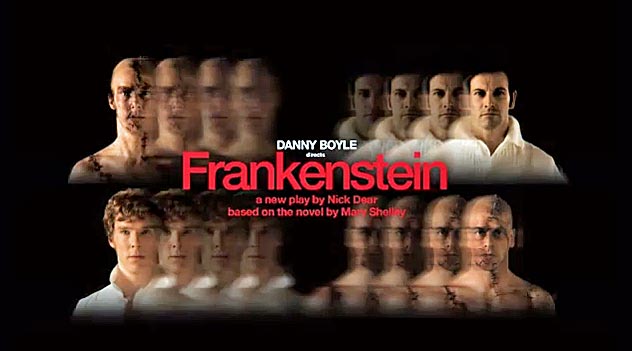
I mentioned in the last post that I saw Danny Boyle's Frankenstein twice. For those of you who don't know, England's National Theatre (perhaps best known on this side of the pond for premiering War Horse, with its stunning puppetry) premiered Nick Dear's version of Frankenstein in 2011. One of the many remarkable things about this version of the play was that the two main characters, Victor Frankenstein and his creation, were played by two actors--Benedict Cumberbatch and Jonny Lee Miller--who switched off roles each night.
http://mediafiles.cineplex.com/Blog/English/FullSize/Blyles-Frankenstein.jpg

Fun fact: both Cumberbatch and Miller are playing modern-day versions of Sherlock Holmes on different sides of the Atlantic. Check out BBC's Sherlock for overall production excellence and CBS's Elementary for a show with an ethic and atmosphere that are actually as contemporary as the setting.

https://blogger.googleusercontent.com/img/b/R29vZ2xl/AVvXsEgC4TczN_QKp98Cn-hEJToyp5LGkcEw4Z1KZDDBacnSpV1OF_1wMoFjbjke7Teyop6xinnKwl7ZAzRDekEdpVfZaUO0hWAM6n920TDWqL8mwPt6OuYQQaGbEU36DcMOHlip-qWQRVu-i50B/s1600/Frankenstein.jpgI couldn't decide which version to see...and I love Mary Shelly's Frankenstein. I've read it four times! So I decided to make this my first major "grown-up" splurge and got a ticket to each version. And, naturally, I wrote down my reactions after each.

For those hoping to avoid the coming thought avalanche, I'll summarize with a (slightly trimmed) text exchange I had with Mom, who wanted to know which version I'd recommend for her, if she wanted to see it.


Me: I've been thinking about what to tell you about Frankenstein. It's a tough call. 
Me: If you want more horror, see Miller as the creature. If you want more pathos, see Cumberbatch's creature. 
Me: I will say no more or I will spoil. 
Mom: Thanks! Excellent comparison in less than 200 words :D 
Me: But I have 8 single-spaced pages if you're interested after you see it. ;) 
Mom: ROFL! Of course you do!

I love how she thought for two seconds that I was capable of restraint!


***DO NOT READ ANY FURTHER IF YOU DO NOT WANT TO READ SPOILERS***
I have made negative-NO attempt to avoid spoiling the play's plot or performances.

Please be aware that the play contains a rape scene, which I discuss at some length. If descriptions and discussions of rape bother you, please don't read further. 


Friday, August 9, 2013

Edmund Talbot and the Upper-Class Subjunctive

The lure of William Golding's Rites of Passage was too strong, so I am rereading the trilogy that I bombed through last spring. I wrote a lot in emails about the plot, the characters, and the narratology, but this time through I'm paying a bit more attention to the finer details. Now that I know how silly he really is, I'm appreciating Edmund's privileged bumbling from the beginning, which means a lot more laughs than confusion about whether I should be taking him seriously. (If the answer is yes, I will find William Golding's grave and we will have words.)

I remembered one line word-for-word from my first read-through. It was short, came up in a powerful scene and...did not seem to make grammatical sense.
Edmund: "He were afraid of drowning."
Were? What the heck? Maybe I only remembered this because, when I watched the BBC version, Edmund said the exact same thing out loud. In the book it might have been a slip in Edmund's writing (this gives Golding a lot of credit), but in the filmed version there is no question that "He were afraid of drowning" is what he actually says.

I'd been wondering about the extent to which Golding's writing style was intentional vs. simply serendipitous. For example, the first book, which Edmund is supposedly writing for his godfather, seemed to have a bit of a higher tone and writing style than the next two, which Edmund writes for himself. Did Golding do this intentionally (Wikipedia seems to think so)? Was it a kind of laziness not to be writing the follow-up in such heavy-handed language? Or had I simply gotten used to the writing by that point? I'll keep you posted. 

But, on this read-through, I found an opposite situation: 
There was a number of officers on the quarterdeck. (RoP 37)
O...kay. 

So what's up with this? Is it some 18th/19th century usage that's gone out of favor; grammatically correct on a technicality; Golding showing us that Talbot is, even in his writing, only human; or something else?

[Quick complaint: I cannot tell you how difficult it is to look up "were" and "was" in grammar books and online. The words are too common to help in the latter and tend to be lumped with moods and tenses rather than indexed on their own in the former.]

The Little, Brown Essential Handbook (6th ed.) and NCSU's Online Writing Lab seem to indicate that this could be an example of the subjunctive mood, but I don't think that's what's going on here. The examples using "were" show "desire or present condition contrary to the fact": "If the theater were in better shape, its future would be guaranteed." 

"He were afraid of drowning" is speculative; at this point in the story, there's no knowing if the character being discussed was, in fact, afraid of drowning. Considering the play that Golding/Edmund have with words whose meanings don't perfectly line up with how they're used (and I know: when a word didn't make sense in its context, I wrote it down and looked it up)(a symptom of changed usage since the 19th century or of Edmund's upper-class superiority?), I'd be willing to accept that that were could be a subjunctive in this situation because the statement is speculation.

But where does that leave us with "There was a number of officers on the quarterdeck"? Surely that isn't speculative or contrary to the fact. It certainly doesn't "indicate a hypothetical state or state contrary to reality, such as a wish, a desire, or an imaginary situation."

Now there's an interesting thought: What if Edmund was--sorry, were just making it up? I sidetracked that thought too quickly by reminding myself that, well, Golding is making it up. There's not exactly evidence, either, or a reason to look for it. So let's drop that idea.

But--but, but, but--I have yet to see anything in my sources to indicate that the subjunctive goes the other way. If it's in Strunk & White, it's not in the index. So a sentence like the one that started this, 
He were afraid of drowning,
passes subjunctive muster while another sentence that might, situationally, work,
Edmund: A few [passengers] would welcome it if you was to conduct a service (RoP 64),
might not.

This last sentence could be another instance of Golding being clever, this time to underline Edmund's privilege: using was makes the sentence indicative, so that he literally indicates what he expects from the reverend to whom he's speaking. (Nevermind that he phrases it as a general request--he's just admitted in the text that he's asking this for selfish reasons, to spite the captain). The situation reminds me of all the talk about why women don't get raises as often or as much as men--society teaches us that men will get their way. Young, white, British, upper-class, be-patroned Edmund is the 19th century's creme de la creme. Why shouldn't he use the indicative was in his "request"? He expects his will to be done because the possibility that it might not does not cross his mind!

That still leaves us with "There was a number of officers on the quarterdeck." Gah! 

I'm Googled out. Anyone else have any thoughts about that one?


Wednesday, June 19, 2013

Sergeant Hathaway, Homosexuality, and Why I Can't Just Love BBC

Here's a post that's a bit more topical and a bit less all-about-me. Though I do have to start it with myself. 

So I guess I have a thing for British TV mystery series. My family started watching more of what came over to Masterpiece Mystery from the BBC after Sherlock rolled through and I've found Inspector Lewis, another show to love. Where Sherlock is extreme, full of Characters-with-a-capital-C and the fantastic, Inspector Lewis is more realistic and down-to-earth, with some characters who could pass in the real world as actual people. And it airs more frequently, always a plus. Another pro is that it's kind of nice to have a show where I have to do the thinking for myself--the Sherlock fandom may have taught me a lot and gotten me thinking, but it also does a lot of thinking for me. Which has both its good and bad effects. 

I watched my most recent episode of Inspector Lewis twice, a first for me with the series. It's called "Life Born of Fire" and it's on Netflix, which is where I watched it. (Inevitable spoilers, by the way--I'm not even going to bother trying not to give the whodunnit away.)

This episode gave a better picture of Sergeant Hathaway, the Benedict Cumberbatch sound-a-like who's Lewis's "better half" or "mini me"--the forensic tech can't decide which. This being a show that focuses mostly on the mystery (hurrah!), there hasn't been much character development for him in the episodes I've seen. Not that I've minded. The series is very much focused on the titular character but it's slow to reveal extraneous details even about him. When I saw Hathaway playing in a little band in a previous episode it was something of a shock to the system. You mean someone other than Lewis has a life outside of their work? 

Granted, that is one of my favorite things in stories: interesting back stories for the non-main characters, the hows and whys of the people in the background. So when Alan Cumming said we'd get to know a bit more about Hathaway, I got interested...until his script had him poking the viewer's brain about why Hathaway is unmarried, lives alone, listens to chamber music, and keeps his apartment neat. Because obviously no man who is or does any of those things can be straight, is the implication. 

On the one hand, interesting: I'm always interested in seeing how women and minorities are treated when they're the focus of any show (rare). On the other hand, I'm already annoyed with the stereotyping and exclusion. 

The episode went on to hit non-heterosexuality high and low, with a wearylingly familiar emphasis on the latter. Some things I did appreciate:

  • A female character who helps the episode pass the Bechdel test actually cites homophobia, rather than some euphemistic "discomfort" or "intolerance", as the reason a religious dean is refusing to permit a Pride march on university grounds. This character also, eventually, turns out to be straight, which is nice since you'd otherwise be forgiven for thinking, based on the episode, that people who are gay and people who aren't don't mix socially at all.
  • Lewis's relatively long-lasting restraint in asking Hathaway about his orientation and reiterations that it's "none of his business"--because it isn't, and it's refreshing to have someone on TV at least acknowledging that, if only respecting it in the breech.
  • Hathaway's little speech to Lewis. Paraphrasing from memory, here: "So, what? There's boys and there's girls and a line down the middle, and if you like shoes and musicals you're gay, and if you read Loaded and eat (some sort of candy/power) bars you're straight?" 
  • Hathaway never does come straight out and label himself. (Oops, pun.) The writer's restraint on that count is, frankly, astonishing. I was also grateful that his secret wasn't a sappy love story, and even more so that it was something that would have actually challenged and changed the character.

Some things I did not appreciate (I'll try to limit myself):

  • With the possible exception of Hathaway (and only because I give him the benefit of the doubt--see the end of the post), there is not a single non-straight person who is not a flaming stereotype, a villain, or dead
  • Homosexuality means gay means men who love men. Women? What women?
  • Obviously any gay man would be willing to undergo a sex change, since the only thing that matters is who they love, not their own body, autonomy, and identity. (Seriously!)
  • Everyone involved in promoting gay rights is aggressively glad that the people who oppose them are dying horrible deaths. Not one, "It's sad but it is better for us," just "Good!" and "Ding dong, the witch is dead!" and the like. It's not a convenient heart attack, it's grisly murder
  • Love is made out to be the only reason you should respect someone who's gay.

I'm getting really sick of that first one: a flaming stereotype, a villain, or dead. Seems like those are the only options in TV/cinema, or at least what I've seen coming from Britain. For all they seem to be more open about homosexuality (in that it actually appears), the pop culture is littered with wink-wink homophobia. I'm not going to go into detail, but here are some of the examples that come to mind: 

  • Sherlock: Obviously. One "It's all fine" shackled with stereotypes (1:3, 2:2); dogged, groundless insinuations (all episodes); villainous non-straights (1:3, 2:1); lesbians who go straight for the main character (2:1) (there are hundreds of posts online breaking down that last oversimplified point).
  • Downton Abbey: Thomas is pretty much evil. Maybe he gets a bit of sympathy towards the end of the last season, but he's still a homophobe's walking nightmare. (For the record, no, I will not be coming back to this show. The soap::interesting character/plot line balance has finally tipped too far even for someone with as much millennial anxiety as I have.)
  • 40-something: Points for a lesbian rather than a gay man, points rescinded since she's mostly homosexual to be a joke.
  • Bridget Jones 2: Saw this when my roommate watched it. Another lesbian, another joke.
  • Doctor Who: Jack Harkness is wonderful for those in the know, but he's another extreme...until you get to Torchwood and get to see that there's a bit more to him than just his sex drive. And it seems like every time the Doctor is standing next to another man, there's a gay joke. Oh, and if the character's a non-straight woman, they're more likely than not going to bite the dust.
  • Bend it Like Beckham: It's been a while since I've seen it, so I could be misremembering, but I think there's a decently sympathetic portrayal of a gay man, and a character gets to say that "there's nothing wrong with being a lesbian"...but again, that second one is mostly undermined by the many cheap laughs surrounding it. (Though I will admit that one of my favorite lines is, "She's not a lesbian, she's a Pisces.")

There is, however, one British film I can think of with one of the few portrayals of homosexuality that made my throat hurt (my equivalent of crying in the theater): Peter Guillam from Tinker, Tailor, Soldier, Spy. For once, sexuality and a raging libido did not define the character. I don't know who was responsible for this, since my dad's read the book and tells me it wasn't in there to begin with, but I would dearly love to shake their hand and thank them. 

But back to Inspector Lewis. Let's play "flaming stereotype, villain, dead," with the self-identified gay characters in this episode, shall we?

  • Will: Dead. His suicide opens the episode. Relatively realistic character, but speak well of the dead and all that, right? Hathaway does say that when Will came out to him, he was under the impression that Will "thought we'd kiss and everything would be rosy" (again, paraphrased), which gave me a twinge of annoyance in the "Is it so impossible for a 14-year-old boy to want to come out to his best male friend without being sexually attracted to said friend?" department. 
  • F.P./Zoe: Villain. S/he's the one who spent three years having a sex change just to try to make his/her boyfriend love him/her without feeling religiously guilty. Because obviously that's a no-brainer choice to make even if you're not transsexual.
  • Conan: Flaming stereotype. Prime example: "Drinks! We need lots and lots of fruity drinks with little pink umbrellas! *gasp* Did I mention I was gay?!" (again, paraphrased)

There's no apparent reason why any average person of any orientation would want to be around any of these people. They don't/barely have lives outside of their sexualities...except for Zoe, who is relegated to the usual woman's role of being there to be the grieving girlfriend for most of the episode. Conan could probably have his own blog post, for all he was a tertiary character in the episode. 

I want to emphasize that he only plays so negatively in the context of the TV stereotyping culture I've already mentioned. Conan's over-the-top, in-your-face attitude is grating when it's only a notch up from the usual portrayal, but it serves an important purpose. The religious right in "Life Born of Fire" are also stereotyped and extreme (though hardly equivalent), but their voices are heard: in the religious institutions, yes, but also in the action of banning a pride march from the university and the ability to set behavioral standards for the community. The only feasible way for Conan can express his right to do and be whatever he wants is to do it loudly and obviously--he could even be deliberately exaggerating stereotypically "gay" behavior to make others uncomfortable. When he's in full, public rallying mode his mannerisms are more balanced, but when he meets Hathaway at a bar and delivers that "pink umbrellas" line, he's probably testing for a reaction. When Lewis has to bring him in for questioning, Conan's behavior is more exaggerated than ever--not a wise move with the police, of course, but as someone who's probably been dragged in front of deans quite a few times, he's probably sick of being singled out. Calculated or not, the controlled stereotypical behavior is pointed. Problem is, when almost all the other gay characters on TV act similarly, that point gets wider and wider until it's about as pointy as a watermelon.

Now, I'm not saying that I wouldn't have been bothered at all if there was maybe one more average-Joe gay character. Frankly, aggressive extremes of almost anything make me a bit uncomfortable: religion, fandom, hobbies, sports, work, culture, countries... I'm generally a chill person; aggression makes me uncomfortable. (It's hard for me to watch blockbuster movies these days, when even the good guys are aggressive extremists.) But it seems as though the ensemble characters in "Life Born of Fire" couldn't be anything but--as though the writer/director was afraid the viewer would miss or disbelieve the fact that someone some guy was gay if they weren't made-up, wrist-flicking, lisping, wearing pink or purple, talking about regular and numerous one-night-stands...etc. 

In fact, in light of this it's almost charming that Cummings opens the episode with relatively less pernicious stereotypes for Hathaway. (Disclaimer: I say "less pernicious" as someone who is not subject to these stereotypes and, therefore, really without right to rank perniciousness.) Cleanliness, an appreciation of wine and classical music...these things would be too subtle for the writers of "Life Born of Fire" to give a gay character. At least not without throwing in some shiny purple furnishings.

I guess what's most frustrating for me is how close this episode and the shows listed above get to making statements about important topics without, ultimately, saying anything. There's a time and a place for changing the culture, it's true, but there are ways to do that without making a documentary. 

  • Cut back the stereotypes. Yeah, flamboyancy is going to be running high at a gay pride march, but there actually are a few homosexual people who don't live and breathe that lifestyle 24/7/52. Have one of the main secondary characters who's introduced in a neutral area not be identifiably gay at a glance, just to shake things up.
  • When you have a character say a Big Idea, try to have them stick to it. 'Course saying one thing and doing another is pretty common, so time and place and all...
  • Was there seriously no LGBT group on Oxford that the directors could have recruited to fill out the crowd scenes? Not only would you get some real people and real exposure, you also wouldn't end up with only fifty people representing an entire city's LGBT and allied population. 
  • At least have the decency to write your sex-changing individual as transgender. Cripes. 
  • For the love of God (how topical), if you're not going to acknowledge the "BT" part of LGBT, at least recognize the other half of homosexuality. 

I'll close with a bit of a pet theory. (In the real world I'd say I have no right to say this, but since I am talking about a fictional character and I did study narratoloy, I think I can get away with it.) The show ultimately seems to say that Hathaway is straight. He kisses and intends to sleep with a woman (yeah, before he know she's a *woman (if she doesn't still identify as male) (did I use the * right?)) and he shows up in the last scene carrying the two items he associated with being straight: a copy of the porn magazine Loaded and the candy/power bar with the name I can't for the life of me remember. But if I hadn't just written hundreds of words about the ham-fisted handling of homosexuality in the episode, I'd be inclined to think that Hathaway was some gradient of asexual. 

I have a few reasons for this, but the main one is that scene in the car with Lewis, when Hathaway, exasperated, tells the DI to go ahead and ask ask him about his sexuality already. Most people would take that opportunity to identify. Hathaway had just admitted how cruel he'd been to his old friend, who'd come out to him when they were fourteen. Being gay would be a comparatively easy admission, and one that Hathaway, with his Oxford education, would definitely link to the now-shameful event he'd just described. Being straight is seen as normal and normative, so it's not like it would be a burden to give up that information. 

Asexuality, on the other hand, is still widely unknown and unrecognized. I've heard otherwise intelligent people say that it doesn't exist, that an asexual person couldn't survive, and that asexual people are essentially plants (which isn't even accurate--most plants reproduce sexually). I've read about people who were told their asexuality was a mental or physical disorder, the result of trauma or abuse, the result of bad sex or no sex. Fact is, people who are asexual were born asexual with the same relative frequency that people who are straight were born straight and people who are homosexual were born homosexual. But asexuality dismissal doesn't just come from straight people--it can come from anyone who grew up with a sexual mindset, which is most of the world's population. This means that even many LGBT communities aren't welcoming, safe places for asexuals. I'm not saying this to knock them; it's just a sad-but-true fact, for the time being.

And here we have Hathaway talking about "a line down the middle" instead of answering a question he gave Lewis permission to ask. There are other ways he could identify, of course, but I'm inclined to lean toward the one that would require more explanation than he'd probably be comfortable with giving. Yeah, he goes home with Zoe, but being asexual doesn't necessarily mean never having sex. There's generally nothing but our minds stopping us from sleeping with anyone regardless of our orientation, after all.

That closing scene gave me such mixed feelings. I was so, so grateful that Hathaway hadn't identified: it left the show open for interpretation and didn't leave me feeling locked out of the entire episode. But I did feel let down by what felt like "reassurance" from the script that, no, don't worry, we don't have to be sympathetic to someone who's gay from now on. Because really, the simple reading of the episode that most viewers would give it does leave us with straight-as-rail Hathaway. I might see the magazine and snack as a joke at his own expense to thank and apologize to Lewis, but wouldn't most people see it as Hathaway admitting which side of the "line down the middle" he falls on? That is, if there was any question left in minds unfamiliar with queer studies that Hathaway wasn't straight; kissing and cuddling with a woman would probably have meant identification to me even a few years ago.

And I think that's why I had to watch this episode twice. I never planned to go into religion as a career, but like Hathaway I had an extremely religious phase. I don't remember doing or saying anything homophobic, but that may just be because I was practically ignorant of the existence of anything but heterosexuality until I was in seventh grade. I thought for a few minutes that Hathaway's transformation from conservative would-be priest to liberal, queer-community-informed sergeant was unrealistic...then I remembered my own growth over the past ten to twelve years. Granted, I was and am significantly younger than Hathaway would have been at both start and present. But still, that radical change, that irrepressible knowledge that I once did and said things that today make me wince at myself, and that desire to confront things that make me uncomfortable are all reasons why "Life Born of Fire" merited a second viewing. I'm probably more annoyed, not less, now that I've seen it again and thought over the points that stood out most to me...but I'm also grateful for the people in my life who helped teach me how to think critically about why shows like Inspector Lewis can seem progressive while also being subtly homophobic.


~~~

I'm not optimistic that I'll get responses, but I'd love to hear from people who have reactions or knowledge they'd like to share.