
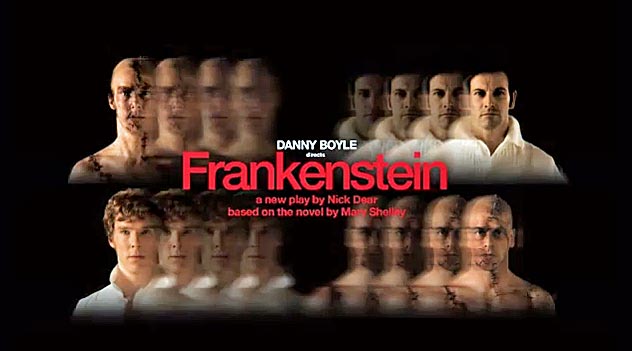
Fun fact: both Cumberbatch and Miller are playing modern-day versions of Sherlock Holmes on different sides of the Atlantic. Check out BBC's Sherlock for overall production excellence and CBS's Elementary for a show with an ethic and atmosphere that are actually as contemporary as the setting.
 I couldn't decide which version to see...and I love Mary Shelly's Frankenstein. I've read it four times! So I decided to make this my first major "grown-up" splurge and got a ticket to each version. And, naturally, I wrote down my reactions after each.
For those hoping to avoid the coming thought avalanche, I'll summarize with a (slightly trimmed) text exchange I had with Mom, who wanted to know which version I'd recommend for her, if she wanted to see it.
Me: I've been thinking about what to tell you about Frankenstein. It's a tough call.
Me: If you want more horror, see Miller as the creature. If you want more pathos, see Cumberbatch's creature.
Me: I will say no more or I will spoil.
Mom: Thanks! Excellent comparison in less than 200 words :D
Me: But I have 8 single-spaced pages if you're interested after you see it. ;)
Mom: ROFL! Of course you do!
I love how she thought for two seconds that I was capable of restraint!
***DO NOT READ ANY FURTHER IF YOU DO NOT WANT TO READ SPOILERS***
I have made negative-NO attempt to avoid spoiling the play's plot or performances.
Please be aware that the play contains a rape scene, which I discuss at some length. If descriptions and discussions of rape bother you, please don't read further.
W 10/30/13 – Benedict Cumberbatch as the creature and Jonny Lee Miller as Victor Frankenstein at NYU’s Skirball Center
So I know why the creature gets listed
first now. I don’t know how the main attraction of this remarkable play went
unremarked: it’s the story told primarily from the creation’s perspective
rather than the usual horror from Victor’s. I was delighted to see it—though
I’m now wondering if I didn’t see these in the wrong order.
Okay, so that’s mostly due to Benedict
Cumberbatch’s fantastic performance and Jonny Lee Miller’s transformation from what little I know of his work. His voice was different! I somehow expect
that Cumberbatch will bring back some pity for Victor, when I think one of the
points of the play is how detestable they both are in the end.
And the end! Okay, obviously I’m partial
to a lack of clear end because it means that it isn’t necessarily the end—the
complete opposite of the book, which ended with both characters’ deaths.

Oh, that set, that marvelous set! I
could live on that set! Okay, maybe
not, but I definitely would love a ceiling of lights like those. Beautiful.
Though the womb imagery in the beginning was a bit heavy-handed for my taste.
I think heavy-handedness is my main
complaint. There are so many lovely little pieces of character interaction that
the extremes were like being hit over the head with the skillet. I mean, Mary
Shelly isn’t exactly subtle—this is the Romantic/proto-Victorian era, subtlety
is not a special concern—but there were uncomfortable extremes in the script.
And I don’t mean uncomfortable in the complimentary way that the writer was
probably aiming for, but uncomfortable in that they didn’t quite sit with the
narrative.
This is all opinion, of course. And I
like to think that I’m not being entirely unreasonable, since I won’t bring up
the wince-worthy discussions about what love is (doesn’t any contemporary
artist notice how little people actually talk about love in real life anymore?
It’s like a forbidden word).
First is the creature’s sudden desire to
burn down the cottage where the Delaceys live. In the book he just runs away.
Well, I say “just.” In the book it’s a powerful moment because the creature has built up
hope—not through the lovely and fun interaction that he had with the old, blind
Delacey in this version, but still. The devastation of lost hope is so crushing
that the creature doesn’t think about going back to revenge himself on the family—and
perhaps I just want to believe this, but I think he probably wouldn’t want to
hurt the old man, especially in this version. Yes, the old man had more faith
in his children than they deserved in this one case, but he was a friend and a
father-figure to the creature. No matter how angry he was at the children, and
even at Delacey senior for making him stay, I can’t believe that the creature
would react by harming him, even to the extent that harming his children would
indirectly harm him.
Second is the rape scene. I knew, from a
review, that it was coming. I think that that,
even more than murder, is the creature’s loss of innocence. He doesn’t torture
people—he kills them quickly. He reacts in the moment, much like a child, and
he does what he has to in order to get attention (“Would you have come if I
killed hundreds in Ingolstadt?”). As appalling as it is, it’s not completely
despicable. None of the murders seem premeditated in this version.
The rape scene, on the other hand,
indicates a great deal of premeditation and a desire to torture. We can’t know
what Frankenstein did to the female creature behind the curtain, but if we
assume that she died quickly, the rape and murder is not at all equivalent,
despite the creature’s claims. It’s also a psychological assault against
Frankenstein rather than a means to an end, as the death of William was—it
requires a whole other level of planning to move from, “if the boy is dead,
Frankenstein will come to me” to “if I rape and murder his new wife, I will hurt him.”
And that willingness to hurt a third person in order to hurt Frankenstein…
I’m not going to sit down and argue
whether rape or murder is worse. They’re not equivalent. But I can’t see any
purpose for the scene to be there other than disgusting misogynistic mentality.
“Now I’m a man.” Seriously? No. That line is there to show the creature’s power
over Frankenstein, who couldn’t satisfy Elizabeth sexually or by providing her
a family—the disgusting mindset that the creature has “taken” something that
“belonged” to Frankenstein. Oh there’s plenty of possessive language about the
female creature, but again it’s almost more innocent in that the creature
doesn’t know any other way to think about people because he hasn’t had that
kind of companion, while Frankenstein thinks of her—as he thinks of him—as an
object rather than a person. Not that everyone in that audience can make that
distinction.

I guess it’s just also bothering me
that…where would the creature pick up this mentality if he can’t get near
people? Even if he saw the younger Delaceys going at it in the woods, it would
have been consensual. Even if he witnessed a rape, how would he know that the
torture of a woman would be socially and psychologically damaging (in terms of
pride, not necessarily actual feeling) to the man in her life? He only got close enough to
one family to hear extended conversations, but I doubt they ever talked about
the social implications of rape for the woman’s “owner”. Do Plutarch and Milton
talk about that? Wouldn’t their proto-Victorian translators have glossed over
Lysistrata -esque details even if the language wasn’t Biblically euphemistic
and muddled to begin with?
Going out on a limb, I want to compare
this reaching for extremes to the even greater ones in Star Trek: Into Darkness. I’m sure I’m just making the connection
because Cumberbatch implicitly links them. The sheer excess of death in that
movie was the full manifestation of this play’s smaller—but, because we
actually know the characters, more devastating—extremes. I probably wouldn’t
complain about them as much if we didn’t have the Shelly to go back to. Well,
okay, I would probably still be muddling through why the writer felt the rape
scene was necessary, but it comes back to the sense I’ve been having of late
that there’s a disturbing lack of consideration about human life in
contemporary fiction. Torture and mass death are plot devices tossed around for
the special effects or the main/titular character’s development.
Things I did appreciate:
- A genuinely ugly creature. Sorry other creatures, you may have been a good actor but rice powder and greasy hair do not ‘frightening’ make.
- The creature’s delight at learning about the natural world. That was, at least, a nice nod to the Romantic era in which the story was written.
- Have I mentioned that gorgeous set? The light bulbs? The struts on the side of the stage that creature slid down? The turntable stage? The railroad line sticking out into the audience? I did think the Frankenstein home on a tilt was a bit hokey. Please, lord, let it not have been tilted to give a better view of the rape.
- Elizabeth with some spunk. It always distresses me when her character is pretty much the same as written, but this one wanted to learn, to explore, to be with someone else. Almost like the creature, really, but without being shunned by society.
- Frankenstein’s dad was black. You go, Danny Boyle!
- An actually informative and interesting pre-show show (as opposed to the one before Macbeth)
- That wonderful final confrontation between the creature and his creator.
- No attempt to explain how Frankenstein created life—don’t mess with fake science, you just look stupid.
All right, so the next one is probably
going to be mostly comparative. Until next week!
> 10/31: Addendum: I said that Victorians weren’t known for
subtlety, but at the same time they were masters of it. Emotions ran high, but
sex and violence were subcurrents. In Dracula,
another Victorian horror favorite of mine, a lack of detailed description of
the vampire’s attacks leave the worst to the imagination—and allow 20th-century
literary analysts to point out that when Dracula makes Mina Harker drink his
blood, the fact that she never gets the word “blood” out can imply the
all-too-common horror of sexual assault. The very fact that the creature
appears in Elizabeth’s room on her wedding night would be horrific in Victorian
times because of everything that could
happen. Wringing the subtlety out of this kind of horror by turning a loaded
murder scene into a raw rape/murder scene…
So what I’m thinking, and I haven’t
thought this through and it’s probably horrific, is that this kind of
(decidedly not contemporary) horror is almost an escape for women…because the
worst thing that happens is death. That’s a sick tangent I won’t go down, that
death might be a less frightening concept than rape. This version
of Frankenstein, for me at least,
doesn’t allow the possibility of ignoring the subtext because it physically
manifests the psychological horror of a threat to women…but it disrespects all three of the characters involved by
removing the woman and the horror of the creature’s actions from the equation.
She’s not just dead, she’s fridged: her death alone provides Frankenstein’s
motivation to pursue his creation to the top of the world. The rape doesn’t
even do anything for the story, except perhaps in the mind of the misogynist
who sees Elizabeth’s torture as an affront to Frankenstein. The creature is
called heartless for killing people but this action is never mentioned again
except when he gloats about it.
I said that the rape scene struck me as
the moment when the creature had truly lost the last shreds of his innocence.
But that profound moment is practically ignored as the conflict becomes two-way
instead of one-sided. Because obviously a woman of color’s rape and murder is
only important in driving the conflict between two white male main characters.
> U 11/3 Note: I keep remembering and inwardly cringing at the
random Lion King-esque music. In the jungle, the mighty jungle...
T 11/5/13: Jonny Lee Miller as
the Creature and Benedict Cumberbatch as Frankenstein at the Leonard Nimoy
Thalia Symphony Space
I was right about Benedict Cumberbatch bringing some pity to the role
of Frankenstein; what I wasn’t expecting was for the handling to make
Frankenstein such a different character.
I guess I thought that with a single director the actors would have a
bit more consistency in how they approached the role. Instead, for all the
similarities between the two plays, the two central characters were so
different that they gave the whole play a very different feel. I think Miller
played the creature a bit more along traditional lines, as a creature of
horror. He seemed angrier, harsher—which did make his terrible actions feel a
bit more expected than when Cumberbatch did them. Though my conviction that the
creature wouldn’t burn down the home of someone who’d been so important to him still
stands, it was a bit more in line with Miller’s creature.
Despite his more traditional horrific handling, I don’t want to make it
sound as though Miller’s creature was simplistic. He had some lovely playful
moments where the inspiration from his two-year-old shone through: biting his
foot, approaching everything in the early scenes by taste, sneaking a swipe at
the falling snow while Delacey is speaking, clinging to the body of the dead
female creation like a child to a safety blanket that’s not doing its job. He
was far more vocal during the opening scenes, which I have mixed feelings
about. On the one hand, yes, it’s more childlike, but on the other it seemed to
play into the grunting creature role that Hollywood has led us to expect—and
which Miller didn’t stray from quite as much as I might have hoped.
 As I mentioned, Cumberbatch made Frankenstein a more even, approachable
character. Not only was he more dynamic on the stage—walking around to fill the
sets, getting on his knees to show shock, and involving his whole body in his gestures—but
he conveyed Frankenstein’s fascination with his scientific endeavor a bit more
clearly than Miller did. Frankenstein in this version still had his enthusiasm
to temper his self- and creation-directed disgust. In the previous version, the narrative focus
felt a bit more like a reversal, with Frankenstein as the “villain” a bit more
reduced of humanity. I suppose that lack makes it a bit more understandable why
he could blunder into as complex a situation as having made a person without thinking about the consequences.
Cumberbatch’s Frankenstein—or maybe this is just my usual expectations of
Cumberbatch's characters—seemed a bit more thoughtful, so that I would have expected a bit
of forethought.
As I mentioned, Cumberbatch made Frankenstein a more even, approachable
character. Not only was he more dynamic on the stage—walking around to fill the
sets, getting on his knees to show shock, and involving his whole body in his gestures—but
he conveyed Frankenstein’s fascination with his scientific endeavor a bit more
clearly than Miller did. Frankenstein in this version still had his enthusiasm
to temper his self- and creation-directed disgust. In the previous version, the narrative focus
felt a bit more like a reversal, with Frankenstein as the “villain” a bit more
reduced of humanity. I suppose that lack makes it a bit more understandable why
he could blunder into as complex a situation as having made a person without thinking about the consequences.
Cumberbatch’s Frankenstein—or maybe this is just my usual expectations of
Cumberbatch's characters—seemed a bit more thoughtful, so that I would have expected a bit
of forethought.
I think I’m back to subtlety—Miller’s creature and his Frankenstein
were both less subtle.
You know the major issue I need to get back to, but as I suspect that
will carry me away from the production, I’ll say a bit more about that first.
Right off the bat I noticed that the production seemed a bit clumsier:
there was less lingering on the “womb”, the lighting was sometimes too dark to
make much out the action, and the camera at first seemed to be zoomed in when I
wanted a big picture and zoomed out when I wanted a close-up. The cuts between
scenes felt faster, rushed somehow. Were these just a result of the fact that
I’d seen the production before and was expecting certain things? I wondered if
this had been the first show filmed, which would explain a bit of time needed
to sort out camera angles and such, but towards the end there were a few pieces
that were done as well as or better than in the previous version.
Close-ups of Frankenstein when he’s nearing completion of the female
creature made it clearer that he was losing it—drinking something (laudanum?)
and all but collapsing with exhaustion—which also helped explain his vision of
William a bit more. Without the close-ups of Frankenstein when Miller was in
the role, it wasn’t perfectly clear what short of figment of what kind of
imagination Will was—was he a product of exhaustion? Did Frankenstein just have
these visions?
 On the flip side, though, was Frankenstein’s display of the female
creature for the male creature. Close ups and angling in the previous version
made clear Frankenstein’s objectification of her body—in this version, it
wasn’t clear whether Frankenstein touched or kissed her as revoltingly
possessively as he had done in the previous show. If I’d seen this version
first and not known what he was doing, I would have been even more disgusted by
Miller’s Frankenstein putting his nasty hands and mouth all over her. Like he’d
have done that to the male creature! I did notice that Cumberbatch didn’t touch
her as much—Miller actually palmed her breasts when he said the word, while
Cumberbatch ran all her features together and just gestured. Maybe that was the
camera angle again and Cumberbatch did feel her up, but I didn’t see it…
Intellectually I know that may very well have been an acting decision on
Miller’s part, but I’ve got a bad feeling I won’t be able to kick that
association as I see more of his work. It’s just too much like the stories of
what some of the other girls experienced in Morocco: getting felt up like a bit
of meat.
On the flip side, though, was Frankenstein’s display of the female
creature for the male creature. Close ups and angling in the previous version
made clear Frankenstein’s objectification of her body—in this version, it
wasn’t clear whether Frankenstein touched or kissed her as revoltingly
possessively as he had done in the previous show. If I’d seen this version
first and not known what he was doing, I would have been even more disgusted by
Miller’s Frankenstein putting his nasty hands and mouth all over her. Like he’d
have done that to the male creature! I did notice that Cumberbatch didn’t touch
her as much—Miller actually palmed her breasts when he said the word, while
Cumberbatch ran all her features together and just gestured. Maybe that was the
camera angle again and Cumberbatch did feel her up, but I didn’t see it…
Intellectually I know that may very well have been an acting decision on
Miller’s part, but I’ve got a bad feeling I won’t be able to kick that
association as I see more of his work. It’s just too much like the stories of
what some of the other girls experienced in Morocco: getting felt up like a bit
of meat.
I took notes last night, so my rambling probably is a bit more
disjointed that last week’s, which I was able to sit down and write all the way
through.
I think William was a better actor this time, and the fact that he,
too, was black made an interesting dynamic. On an ABC Family show I would just
think of last week’s performance as colorblind casting—after all, I’m pretty
sure that the stepsisters in Cinderella
weren’t of the same background, but I couldn’t say that for sure. Pushing the
Frankenstein family in that unexpected direction could well change the story. I
don’t think Frankenstein ever says “father,” so while most people—especially
those who’d read the book or seen, for example, the Kenneth Branaugh or BBC adaptations—would
recognize that they’re biologically related, it is possible to read the family
in a way opposite to the “original” (can’t remember if Elizabeth was actually a
cousin in the book). Victor could be the adopted, foundling Frankenstein—which actually
works even if he does say “father.” This interpretation aligns him and sets him
in contrast even more with the creature, another orphan albeit one who did not
receive the patronage, home, and family that Victor did. It also places him as
something of a freak and a monster in his own right: even though he might be
adopted and depending on the charity of his relatives, as an educated,
upper class white man he automatically has more social power than even the head
of the family. It’s not something the play explores (obviously—it was probably
written with a one-“race” cast in mind), but it’s an undercurrent that I
couldn’t help noticing, especially when Victor argues with his father.
The moment in which the creature decides to burn down the Delacey’s
house was what really made me remember that debate. The words and the script
were telling us that the creature was driven by nurture: he’d learned through
his readings that great men who are angry and hurt seek revenge by hurting
others. But this argument ignores Delacey’s influence. The old man was so
insistent in seeing the good in things, in explaining that the bad bits of
Milton and Plutarch aren’t necessarily the way the world does or has to work,
and his (almost as ham-fisted as the love monologue) speech about original sin
clearly shows that he shares his idea of people born innocent and good but
corrupted by society. But none of that good influence stuck when push came to
shove, and instead of having the creature driven by distress to harm those who
hurt him, we have an almost animalistic desire to revenge—even when doing so
will harm his good, best, and only friend, who now doesn’t merit even a thought
in the creature’s plans.
I think that’s a more textual complaint than a production one. Even if
Cumberbatch played the creature with more humanity, the script didn’t have the
words for that scene to be any more complex than an angry person seeking
revenge without thinking of the consequences. It seems inconsistent—and if the
creature’s dislike of inconsistency is anything to go by, that’s not something
I would have expected Dear to allow.
And now, through the nature vs. nurture debate, I bring us back to the
rape. The same online person who commented that Cumberbatch made a better
Frankenstein also said that Miller played the rape scene more…realistically, or
something like that (and preferred Cumberbatch’s handling of the scene for that
reason). Not quite sure what they meant, but the salient point is that, even
though Miller’s creature’s preemptive (pathetic) “apology” seemed more sincere,
he actually seemed to take pleasure in the act. While Cumberbatch’s creature
didn’t quite seem to know what he was doing (nurture), Miller’s seemed to know
instinctively what to do—which, in hindsight, seems almost animalistic, as
though the knowledge was ingrained (nature). The idea was reinforced by the way
he practically barked with each
thrust. Cumberbatch’s relative quietness left room for (to me) Elizabeth’s
sickening silence to resonate; Miller’s noise once again made his creature the
object of terror by focusing the scene on him instead of on the act or on the
victim. The psychological fear I felt seeing Cumberbatch’s creature was much
more visceral with Miller’s—not in a this-is-good-acting way, but a
if-I-didn’t-know-it-was-almost-over-I-might-think-about-leaving way.
Once again Miller’s creature was more expected: the uncontrollable male
undone by female beauty and overwhelmed by the lure of sex finished his rape
with an orgasm. Because what’s the point of rape if not to climax, right?
Perhaps that’s a bit of twisted innocence on Dear's part. Many rapists don’t climax, because a rape is almost
never about the sex—it’s about the power, the dominance. Cumberbatch’s creature
didn’t obviously reach orgasm. There may only be about five people in the world
who know why, and my thinking is definitely shaped by my substantial intake of Frankenstein literature and movies and
sympathetic-to-a-point feelings about the creature…but I wonder if it’s because
of the creature’s remorse—some remaining innocence and that knowledge of right
and wrong he claimed to have—or because Cumberbatch actually knew that fact
about rapists, or a combination of both.
In a purely practical and moral sense, I prefer Cumberbatch’s take.
Despite how cynical I can be, I do genuinely want to believe that people are
essentially good, that society shapes them and bends them to extremes. Artistically,
I’m not going to choose. I still don’t fully understand the purpose of
transforming a murder with the threat of rape into a rape-murder. On a purely
narrative level it’s a matter of how complex you want your characters—and I’m
definitely all for complexity (obviously).
I know most people’s reactions to this would probably include something
along the lines of, “Why focus so much on one scene in an entire two-hour
play?” Quite aside from the fact that the entire half of the world’s population to which I belong is horrendously
underrepresented in media, I do see the scene as a climax of sorts. It’s the
worst that the creature does, raping and murdering the only person who he
considers “perfect” just to get revenge. (Yet another villain failing to look
at the big picture—my impatience with the state of contemporary culture sets in
again!) But despite the horror of the scene in the high point of the play, it’s
practically swept under the rug to make room for Frankenstein’s final pursuit
of his creation.
The scene also seems to draw important parallels between Elizabeth and
the creation, though these are neglected, in large part because the scene is so
inconclusive. Frankenstein shows little concern for Elizabeth until her death
(Miller’s Frankenstein’s “I do love you” feels more like convention, saying the
expected, than Cumberbatch’s at least sincere-sounding delivery (whether or not
it actually is sincere is another matter)). Then, in the final scene, we have
his accusation: “You killed my wife!” My
wife. When he made the creature, he did not think about the consequences;
only when his actions shackled him to the creature did he feel any
responsibility—only when he acknowledged that the creature was his, when he thought of the creation as
a possession rather than a particularly ugly piece of furniture in a cluttered
life. In much the same way, he does not take responsibility for Elizabeth until
the consequences of his actions have become apparent. Only once she is “his”
does he show consideration for her…and only once he has lost control of her
(through, ultimately, his neglect) does he take responsibility for her. Even
though he still places all the blame on the creature instead of sparing any for
himself.
 That’s a parallel I would have liked to see explored more: that of the
creature and Elizabeth. Not very similar in many superficial ways: poor and
wealthy, male and female, even (in this production) white and black. But both
have been heavily shaped by society and its expectations. Both want to be part
of a bigger world but are constrained by the roles decided for them by others:
the hideous creature cannot enter society and the delicate woman cannot travel
to new societies. Both want to be educated but are denied proper schooling: the
creature expresses immense frustration with how little he seems to know and
Elizabeth “was not allowed to go to school”, which suggests that she did, in
fact, want to go (unlike a more passive “didn’t go to school”). Both are only
considered important by the people they care about in their position as
objects: the creature as an experiment to be displayed and improved upon,
Elizabeth as a prize beauty and childbearing vessel that can be ignored or
picked up as convenient. Both want family, though their means of getting it are
different. Both are ignored by the person who ought to be responsible for them,
who they feel should love them. Both try to compromise with Frankenstein: the
creature for banishment in exchange for a companion who will give him children,
Elizabeth for a late marriage in exchange for a companion who will give her
children. Frankenstein abandons them both to pursue his own interests. Even his
reluctance to touch Elizabeth reflects his treatment of the creature.
That’s a parallel I would have liked to see explored more: that of the
creature and Elizabeth. Not very similar in many superficial ways: poor and
wealthy, male and female, even (in this production) white and black. But both
have been heavily shaped by society and its expectations. Both want to be part
of a bigger world but are constrained by the roles decided for them by others:
the hideous creature cannot enter society and the delicate woman cannot travel
to new societies. Both want to be educated but are denied proper schooling: the
creature expresses immense frustration with how little he seems to know and
Elizabeth “was not allowed to go to school”, which suggests that she did, in
fact, want to go (unlike a more passive “didn’t go to school”). Both are only
considered important by the people they care about in their position as
objects: the creature as an experiment to be displayed and improved upon,
Elizabeth as a prize beauty and childbearing vessel that can be ignored or
picked up as convenient. Both want family, though their means of getting it are
different. Both are ignored by the person who ought to be responsible for them,
who they feel should love them. Both try to compromise with Frankenstein: the
creature for banishment in exchange for a companion who will give him children,
Elizabeth for a late marriage in exchange for a companion who will give her
children. Frankenstein abandons them both to pursue his own interests. Even his
reluctance to touch Elizabeth reflects his treatment of the creature.
If the creature (coughthecoughnarrativecough) had two brain cells to rub
together, he’d hold to that alliance with Elizabeth. They have more in common
than either of them do with Frankenstein and could have made good allies in
giving Frankenstein a good smack upside the ego. But, alas, even the most
intelligent villains do not know how to plan for the long-term. (Lookin’ at
you, “Khan.”)
A quick comment about the audiences: The first, at NYU, was
clearly younger, on average, than the audience at LMT—though both audiences
were younger than that at Macbeth. I’ll assume that the younger audience has
been watching Sherlock and other
British shows with more subtle humor and sarcasm (“zany British humor,” to quote
Cabin Pressure) than American shows,
so there was a bit more laughter at the spots of humor in the play at the NYU
screening. The audience there also applauded at the end of the show, though
that could also be a result of a higher concentration of art students—I
definitely heard people near my own age talking about the set and other design
elements.
Aside from the jokes, the only real time that the audience reacted
collectively was during the rape scene. At NYU I didn’t particularly notice any
reactions until the creature snapped Elizabeth’s neck—then there was a round of
gasps. LMT was similar, but there was also an audible intake of breath when the
creature announced that he’d learned how to lie. I don’t know what to do with
the fact that I didn’t hear any reactions to the rape itself. Granted it wasn’t
a moment but a drawn-out scene, so there wasn’t any collective noise—that could
well be the only reason. But they didn’t react as strongly to Frankenstein’s
destruction (murder?) of the female creature either, though I did hear some
reactions at LMT. Perhaps it’s just that that first murder was behind a
curtain, invisible, while the creature’s deeds were on full view—and he did, of
course, add an element of torture that Frankenstein did not indulge in. Might
he have if he had time alone with her? His willingness to kiss a woman created
from a corpse suggests that he might have—it’s a strong action simply to make a
point, especially when doing it could very easily have enraged the existing
creature, but Frankenstein’s obsession with her perfection is more demonstrated
than his feelings for any of his family or for Elizabeth.

Oh, another thought related to inconsistency: The highly choreographed bits of the opening scenes, complete with music and, in one case, even singing, stand out because of how completely they disappear after the creature burns down the Delacey’s house. Charitably, I can think of a reason: To someone so new to the world but with an adult brain (as one of the two main actors pointed out in the pre-play video), the world was probably a confusing jumble of complexity and simplicity. The complex and confusing came with the railroad workers and the carousers, while the choreography mapped the ease with which they would have seemed to fit into their places to someone still mastering the ability to walk—it looks simple and rote when they do it, but complex and difficult to apply to yourself. Everything is simpler in the more conventional sense with fewer people around, of course, but the dream still shows his inability to fully grasp the connection between two people, specifically between two people in love. He can follow her movements to some extent, but she dances alone for the most part and moves in ways too complex for him to follow. A duet dance would have had a very different meaning than the solo does.
Finally, since the thoughts about the last showing ended with a comment
about the music, I’ll say that the weird Lion King music was less jarring this
time. Instead I’ve been thinking about the lovely simple music that accompanied
the scene in which the creature imagines dancing with a female like him. It’s
very familiar music, though I’m not sure if it was a preexisting piece or if it
just sounds like something I’ve heard before.
I’ll add to my list of highlights:
- Both creatures’ reactions to Frankenstein’s agreement to create a female: Cumberbatch’s delighted clapping and Miller’s astonished happiness
- Complaint: there’s no way that no one would have suggested that Frankenstein was behind the murders. He was missing for all three, found present and in position to have committed two (I'm counting the murder/destruction of the female creature)
- That final parting image as Frankenstein and his creation walk into the blinding white door
- The light bulbs are definitely worth another mention!
- The creature chewing on Frankenstein’s journal—amusing in that a child chewing a book is a common enough occurrence, but devastating in that it’s hunger rather than teething that has driven him to try it
- The contemporary snark about the creature’s ability to quote Milton and read Plutarch—Cumberbatch definitely pulled off Frankenstein’s disbelieving astonishment for laughs, and it worked better than Miller’s more text-canonical reaction in that it met the audience halfway. Perhaps Shelly wrote such things in all seriousness, but it is pretty funny to a modern audience, many of whom would struggle to understand those books—how much of it is parroting and how much is understanding? There’s no way to know until the creature says that he sympathizes with Satan…another heavy-handed moment with none of the relief of a touch of humor that his recitation allows.
- The rotating stage. I’ve seen it in a couple Broadway shows (The Lion King, amusingly enough, comes most readily to mind), but only ever used as a means of moving the set. The actors actually stood on the stage as it revolved and used the motion, especially in the final scene.
- Other delightful aspects of the set included the smoking sunken pit and the raising and lowering lakeside docks. The latter did feel a bit obviously for spectacle, but the simplicity of the final setup used in the scene countered that. The former was put to great use when Frankenstein’s sleigh rose up—and the rotating stage used subsequently to redirect the path of his motion. Also the use of the rails—although only necessary for one scene, the extension jutting off the stage was used to great effect in the graveyard scene and not neglected. The whole set was well-used.
- Frankenstein’s sideburns in both incarnations. Hee hee hee!
- The creature’s deteriorating costume. I’m sure some of that was just exertion and sweat—can’t imagine how hot those light bulbs must have made an already strenuous play—but it did help to measure time passing when the creature was a bit more rumpled every time he came out to visit old Delacey.
- Not effective: the (lack of) rocky field. Really, Danny? So much beauty and creativity in the set and you couldn’t find something to make it clearer what the heck Felix and his wife were on about?
- Cumberbatch’s Frankenstein’s distraction with bits of human anatomy—Elizabeth’s, his own, Will’s
- Early reference to Frankenstein’s tendency to break down in difficult situations and to his “nervous collapse” in Scotland. It's the reason why the book's titular character drives me up the wall, but it also lets us know that Frankenstein's not exactly a stable role model himself.
- Playfully avoiding the “how” of creating life—“I can’t tell you that, you’re just a child!”

> 11/8 Note: As soon as I got internet in my apartment and hit Tumblr, lo, a post discussing rape vs. murder appeared. Perfect timing for this discussion. You can read the post here: http://afternoonsnoozebutton.com/post/27126498887/why-rape-jokes-are-uniquely-bad

No comments:
Post a Comment